
Commercial Roofing in West Fork, AR
Commercial roofing in West Fork, AR: roof inspections, leak and drainage repair, school and small business roof care, and replacement planning for owners.
A town of 2,331 people, which is what West Fork counted in 2020, tends to run on small buildings with small budgets, and a roof surprise lands hard on all of them. The owner of a shop, a clinic office or a church hall gets a call about a stain, and the choice is between a repair that fits this month's money and a bigger project that needs a reserve line. We walk the roof, photograph what we find and give a rough budget range for each path, so the decision does not wait on guesswork.
The West Fork of the White River flows along the east side of town, and West Fork Public Schools serve the city. Property lists that include Fayetteville or Prairie Grove can share one visit schedule with West Fork, with a single ranked report for all the roofs.
Water everywhere: rain, runoff and the roof drain
Drake Field in Fayetteville gets 46.96 inches of precipitation in a normal year, on about 113 days of measurable rain, and May alone brings 5.89 inches. The river runs along the east side of town, and rain is what lands on every roof. Rain, runoff from a clogged edge and ponding at a slow drain are the three ways water stays on a flat roof. A wet climate rewards a roof with clean drains and punishes one with standing water.
On a first walk we measure how long water sits after rain, check every drain and scupper for debris, and look at the membrane around the outlet for movement. Ponds leave residue rings and algae. A slow drain is often a small fix, but a low spot in the deck means added drains or tapered insulation. Our ponding water roof repair work starts by finding which of the two you have.
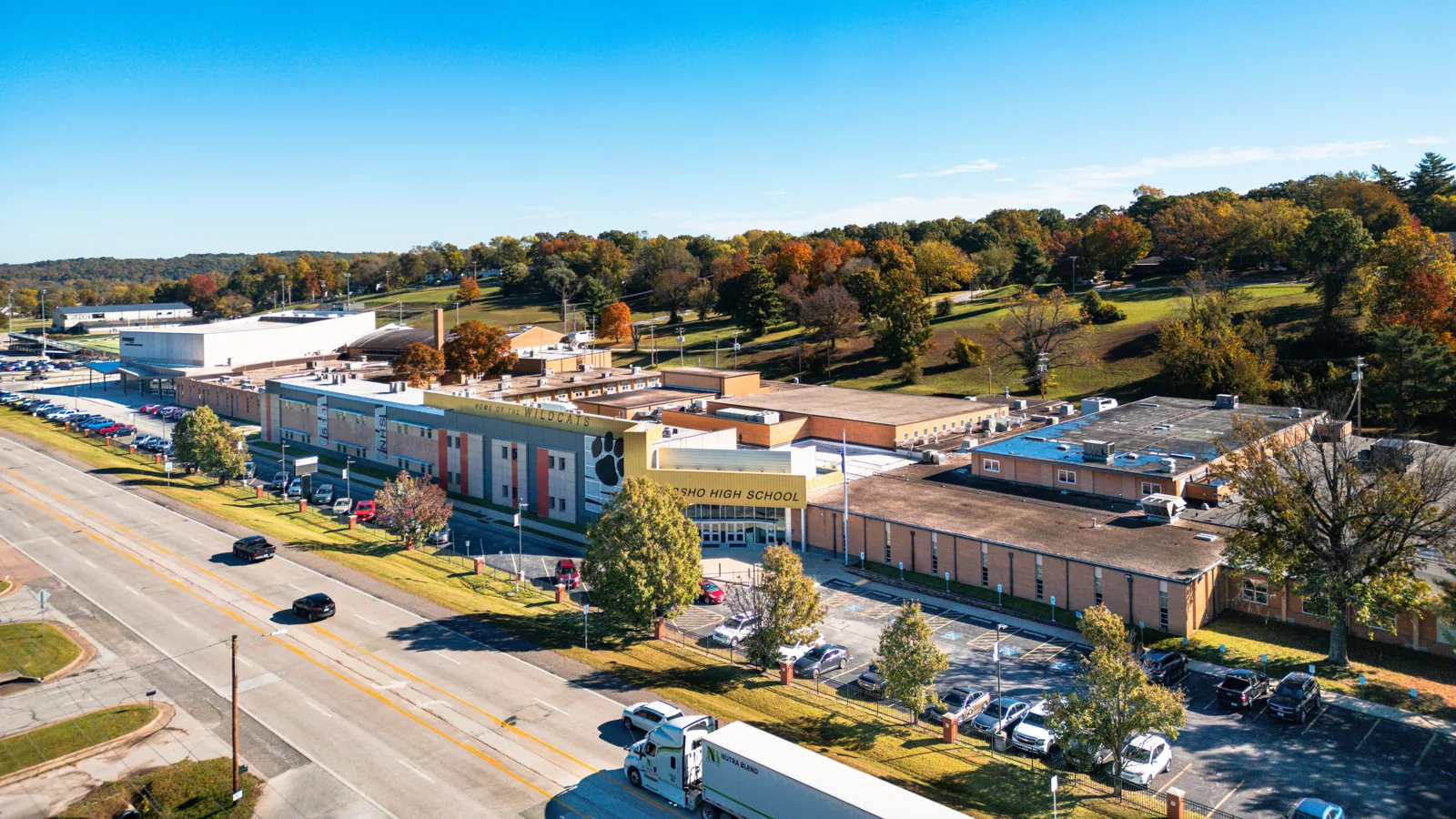
School and public-use buildings: summer is the work window
Public schools have a roofing calendar that private buildings do not. Students and staff leave in late spring, and the building sits quiet until August, which is the natural window for tear-off and larger repairs. The roof decision has to be made well before that, usually in the winter budget cycle. A district facilities manager needs a condition report by February or March to fit a project into the summer, and a quote that holds through the bidding process.
West Fork Public Schools serve the city, and each school roof gets walked before a scope is written. For any school roofing project, we document the roof with photographs and moisture findings, give a ranked list of what needs work now and later, and plan around safety rules for work near students. Leaks over classrooms in a school year get a same-day temporary seal and a summer fix.
What we mark on the roof walk
The walk is a grid. Across the field we press on the surface for spongy insulation and watch for blisters, open laps and patches that have begun to lift. At the perimeter, we check edge metal, coping and wall flashing for movement. At each penetration, we look at boots, collars and sealant.
We write down where each item sits on the roof, photograph it and rank it as urgent, this year or watch. That report works for a property manager who has to justify spend to an owner, and for a board or district that needs written scope before approving funds. For a roof where wet insulation is suspected but not obvious, an infrared moisture survey maps the wet areas, and a core sample confirms them before any decision on replacement.
Access gets recorded too: where the ladder or hatch is, whether the roof can carry foot traffic, and which rooftop units need a shutdown before we work near them. Those notes save time on the repair visit and keep the cost estimate accurate.
Flashing and sealant: the small parts that open first
Most leaks we trace start at a joint, not in the middle of a membrane. Wall flashing separates as the roof and wall move at different rates. Curb corners open. Sealant on penetrations cracks in a freeze-and-thaw week, and Fayetteville has seen about 10 days a year with highs below freezing and a low of minus 20 F in February 2021.
A flashing failure repair usually means cleaning the surface, replacing the failed flashing or sealant and checking the surrounding membrane for damage. It is a short visit and a modest cost. If the same joint has been patched several times, we say so and discuss a more durable detail, such as new counterflashing or a prefabricated corner. A roof that is otherwise sound should not be replaced because one joint was patched with the wrong material.
Reserve budget: planning the dollars before the leak
A reserve line needs two numbers: the year the roof will need replacing and the cost range when it does. A written condition report supplies both. We give each roof a rough remaining life, list the repairs that would extend it and price a replacement range, so the reserve line can be set.
A preventive roof maintenance routine ties into that plan. Drains cleared each spring, sealant touched up each fall and photographs added to the file keep small defects small. Each visit also tells us how fast the roof is aging, so the replacement year can move up or back with real evidence rather than a calendar guess. If a storm arrives, the file also gives an insurer a before picture to compare with the after.
Questions About West Fork
Commercial Roofing Questions
We are a small congregation with a flat roof over our hall. Where do we start?
Start with a walk, so you know what you have. We photograph the roof, find the leak source, and tell you whether the repair is a patch or the start of a bigger project. You then take a written report to the board, with a rough range for each option, and decide on a timeline that fits the offering plan.
Does living near a river make a roof wear faster?
The roof mostly responds to rain, sun, wind and temperature swing, not to the river itself. What matters is how well the roof drains and how well it is sealed. A building in a wet region needs clean drains and tight flashing, and those are the two things we check first on any walk.
A school wants a roof quote this winter for summer work. How much lead time is needed?
As much as the bid process allows. We can deliver a condition report in a few weeks after the walk, and the quote follows. Ordering membrane and insulation can take time as well, so decisions made by spring leave room for a summer start and a punch list before classes return.
A repair crew patched the same spot twice. What is going wrong?
A repeat leak usually means the patch is treating the symptom. The real entry point may sit upslope, or the underlying flashing may be failing. We trace the water path, open the area if needed and replace the failed detail, so the third visit is not necessary.
What happens to the schedule if a storm hits the week the crew is booked?
We stabilize any roof that has been opened and protect the interior first, then move the planned work to the next dry window. Fayetteville averages about 113 days of measurable rain a year, so weather days are built into the calendar. You hear from us the same day about what changed and when the crew returns.
Related Commercial Roofing Pages
Read how we handle this work in Fayetteville, AR
Read how we handle this work in Fayetteville, AR
Read how we handle this work in Fayetteville, AR
Read how we handle this work in Fayetteville, AR
Read how we handle this work in Fayetteville, AR
Read how we handle this work in Fayetteville, AR
Read how we handle this work in Fayetteville, AR
