
Flashing Failure Repair in Fayetteville, AR
Repair failed base flashing, counterflashing, curb flashing and sealant on commercial roofs in Fayetteville, AR, priced by detail.
Most leaks on a commercial roof do not come from the big flat field. They come from the joints: where the roof meets a wall, where a pipe goes through, where a curb carries a unit. Those joints are sealed by flashing, and flashing is thin metal, membrane or sealant that has to move with the building through every season. When one fails, the tenant sees a stain, and the property manager sees a repeat call.
A flashing repair is usually the cheapest roof repair there is, and the one most often done wrong. A bead of sealant over a gap holds for a season, then opens again. We aim to find why the flashing failed and fix that, so the work order does not come back.
Wall joints: base flashing, counterflashing and the termination
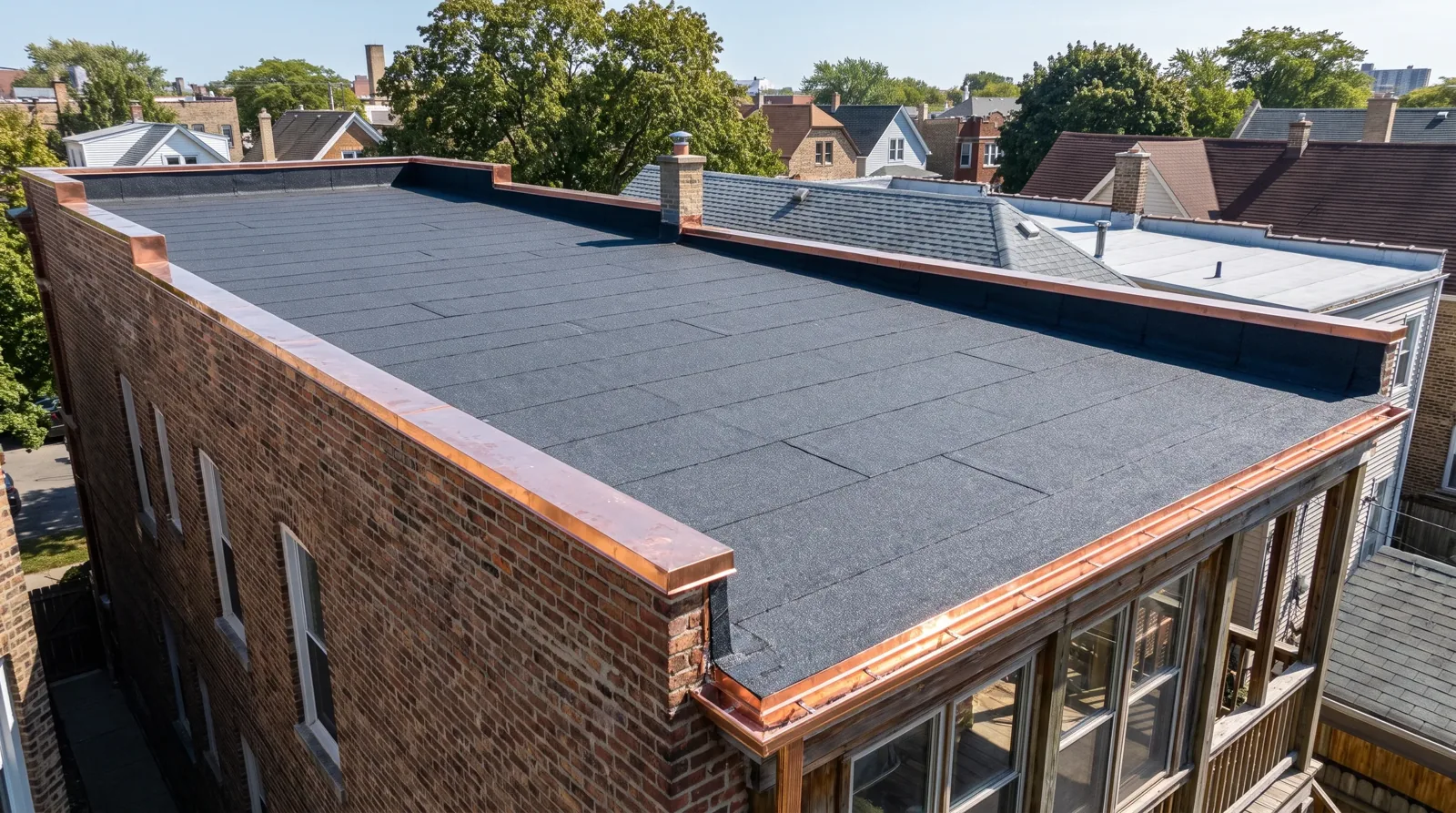
Where a roof meets a wall, the membrane turns up the wall as base flashing, and a metal or sealed counterflashing covers its top edge. Failure points are predictable: the membrane pulls away from the wall, the top edge opens, fasteners back out, sealant dries and cracks, or the counterflashing bends. We walk every wall line, press along the termination and look for gaps, lifted sections and water staining on the wall.
The repair depends on the failure. A loose termination can be re-adhered and sealed with a termination bar. A cracked sealant joint can be cut out and redone with the right material. A failed membrane turn-up may need a new strip welded or adhered in. In a masonry wall, the reglet or mortar joint may need repair. We write each fix by location so the work order is precise.
Edge terminations at gutters and fascia are the other side of the wall joint. Where the membrane runs over the edge, we check the drip edge, the sealant under it and the fasteners. A gutter that pulls away from the building lets water behind the fascia and onto the deck edge. We re-secure, reseal and flash these joints so water runs into the gutter and not behind it, and we note any rot or rust that needs deeper repair.
Penetrations and curbs: pipes, vents and rooftop units
Every pipe, vent and conduit through a roof has a boot or a flashing, and each is a small place for water to enter. Rubber boots crack in the sun. Pitch pans dry out and shrink. Sealant at a clamp fails. Curbs for rooftop units have corners and seams that need to be wrapped carefully, and they take movement every time the unit starts and stops.
We check each one, press the sealant, look for splits and test the flashing height. Water ponding around a curb is a warning. We repair with the right part for the job: new boots, replaced pitch pans, welded or adhered corner patches, or full wraps on a curb. Where a boot has failed on a pipe that gets hot, we pick a material rated for the temperature instead of the cheapest option on the truck. Each of these gets the treatment used for skylight and penetration flashing, and we mark every repaired point on the sketch.
Movement: heat, freeze and why sealant gives up
Fayetteville's weather moves a roof. July highs average 88.7 F, highs above 100 F show up about three times a year, and the record is 111 F. In winter, roughly ten days a year stay below freezing and about 6.5 inches of snow falls. Metal expands and contracts, membranes shrink and sealants harden and crack through those swings. A flashing that was tight at install can open after a few seasons.
That is why sealant alone is a weak fix. A joint that moves needs a repair that allows for it: a lap, a termination bar, a flexible membrane strip or an expansion detail. Where a flashing is fastened tight to a wall that moves independently, we rework the connection. The repair has to match the movement, or the leak returns in the next hot or cold spell.
Rain: where the water goes when a flashing opens
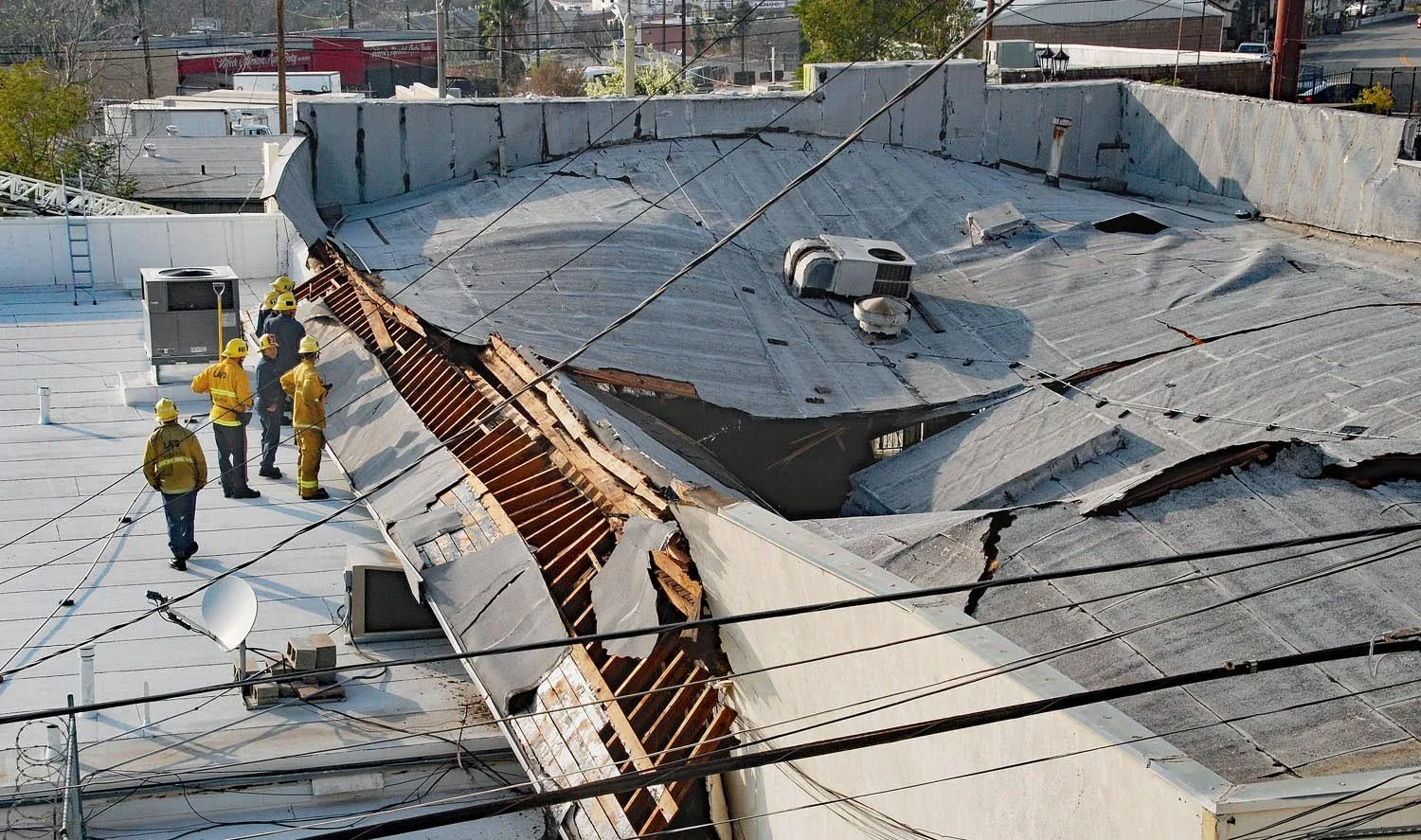
The city gets around 47 inches of precipitation over roughly 113 days, and May is the wettest month. Water entering at a flashing can travel along the deck, drop through a joint or follow a pipe, then show up as a stain far from the failure. We work upslope from the stain, check seams and flashings in the path and use a water test on a small area when the source is unclear.
If water has been getting in for a while, insulation may be wet. We scan for moisture and core when needed. Wet insulation near a wall or curb should be removed and replaced before the flashing is rebuilt, or the new flashing sits on a wet base. This is where a commercial roof leak repair becomes a small section repair, and the sooner it is caught, the smaller the section. Ponding next to a wall often comes with it, and a ponding water repair becomes part of the fix when a low spot holds water against the flashing.
Large single-level roofs have long wall lines and many curbs. Large single-level retail, such as Northwest Arkansas Mall with about 820,000 leasable square feet, can mean long wall lines and many rooftop units to check. We plan the walk by wall length and curb count so no joint is skipped.
Records: a map of every repaired detail
A flashing repair is only as useful as its record. We photograph each detail before and after, mark it on the roof sketch, note the material used and the date, and list any neighbors with similar wear. The next visit then starts from facts. If the same detail fails twice, the record shows it and points to a deeper cause.
Older buildings can have more to check. The historic Square in Fayetteville holds buildings dating from 1886 to 1911, and a building of that age may have wall-to-roof joints that have been worked over more than once. What sits behind a parapet is known only after we pull the cap and look. If you manage buildings in Fayetteville or Farmington, we can cover them on one trip, and buildings in Springdale along US 412 can join the same route. When a wall joint keeps opening, the seams beside it deserve a look too, and seam failure repair often follows.
Questions About Flashing Failure Repair
Commercial Roofing Questions
Why does my roof leak at the same wall every time?
Because the repair addressed the symptom. A sealant bead over a moving joint opens again. We find why the flashing moved or failed and rebuild it to allow for the movement.
Can flashing be repaired without replacing the roof?
Usually, yes. Most flashing repairs are local and cost far less than reroofing. If the membrane near the flashing is failing across a wide area, the plan changes.
How do you test for a flashing leak?
We trace the water upslope, inspect the joint, and when needed run a hose on a small area while someone watches below. The test isolates the entry point.
Which is better, sealant or metal?
Each has a place. Metal counterflashing sheds water and lasts. Sealant fills small gaps but needs upkeep. We use metal where we can and sealant where it fits, and we explain the choice.
How often should flashings be checked?
At least once a year, in spring before storm season, and after a major hail or wind event. A short walk finds the cracks while they are small.
Related Commercial Roofing Pages
Read how we handle this work in Fayetteville, AR
Read how we handle this work in Fayetteville, AR
Read how we handle this work in Fayetteville, AR
Read how we handle this work in Fayetteville, AR
Read how we handle this work in Fayetteville, AR
Read how we handle this work in Fayetteville, AR
