Infrared Roof Moisture Survey in Fayetteville, AR
Infrared and core-cut roof moisture surveys in Fayetteville, AR that map wet insulation so you can choose between repair, recover and replacement.
Wet insulation is the line item nobody sees until the quote arrives. A roof can look fine from the parking lot and still hold water in the board stock, soaked from a slow leak that started two winters ago. That water adds weight, cuts the insulation value and keeps feeding new leaks through the membrane. A moisture survey finds it, draws it on a plan and turns a guess into a measured area, so the owner can spend money on the part of the roof that needs it.
For a property manager in Fayetteville, AR facing a repair-or-replace decision, this survey is often the most useful few hours of roof work in the whole process. It tells you whether a patch will hold, whether a recover is possible and how much of a replacement budget goes to wet material.
Method: how infrared finds what the eye cannot
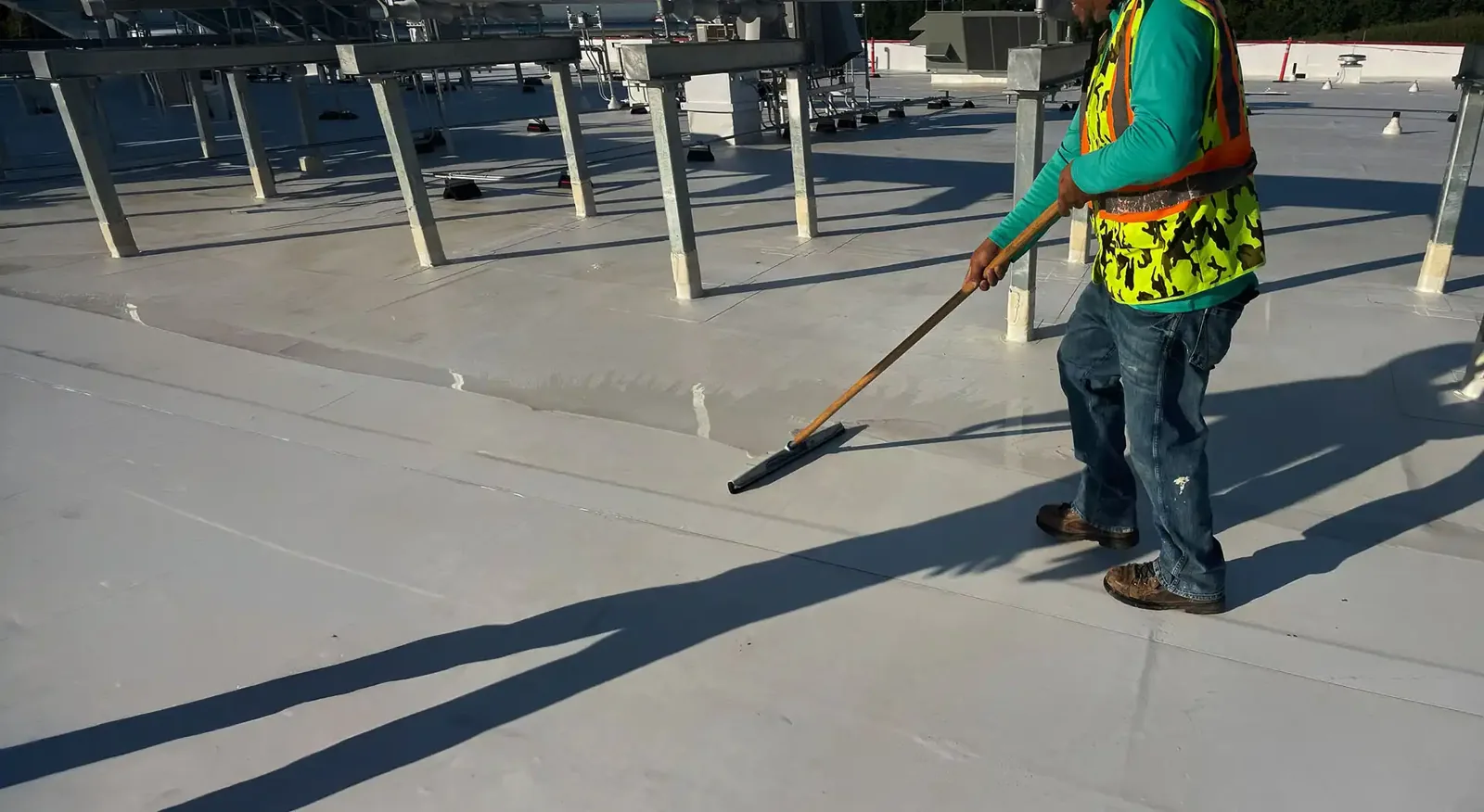
Wet insulation holds heat longer than dry insulation. After a sunny day, a thermal camera pointed at the roof at dusk shows wet areas as warmer patches while the dry areas cool off. We scan the roof on foot with a handheld camera or from the air with a drone, then mark the suspect areas directly on the membrane with paint or on a roof plan with coordinates.
Infrared works best on roofs with absorbent insulation under a membrane, in clear conditions with a good temperature swing. It is a screening tool. We confirm what it flags with a moisture meter and a few core cuts, because a warm patch can also be a heavier insulation layer, a ballast concentration or a dark patch of surface dirt. The scan narrows the search, and the cores settle it.
Cores: the proof under the surface
A core cut is a small circular sample taken through the roof to the deck. It shows how many layers there are, what each one is, whether the insulation is wet and whether the deck has rust or rot. We seal each cut the same day with compatible material so the roof is left tighter than the cut found it. The cores also tell us about the roof's history, such as an old layer beneath the current one that nobody remembered.
The results go on a plan beside the infrared map. Where the cores confirm moisture, the plan marks the area to be removed. Where they find dry board under a warm patch, the area is cleared. That combination of a map and samples is the evidence behind a recover decision and behind a replacement scope that has a firm quantity for wet insulation, not an allowance.
Timing: when the survey works best
Dry weather and a warm sunny day give the best thermal contrast, so spring and fall tend to be good times for the survey. Fayetteville's wettest month is May, at about 5.89 inches at Drake Field, and a roof that has just been through weeks of rain will show different patterns from a roof that has had a dry spell. We usually wait for a few dry days so surface water does not confuse the scan.
Freeze and thaw also matters. Roughly ten days a year here the high stays below freezing, and moisture trapped in insulation expands in those cycles. A survey in late winter or early spring, before the storm lines arrive, finds the damage the season left behind and gives the owner time to plan the work for a calm month.
Uses: what the map is worth
The map pays off in several places. It limits a repair to the wet area so the owner does not replace dry roof. It supports a capital request with numbers. It gives an insurer a baseline after a hailstorm like the May 2020 event east of Fayetteville, which reported stones up to 3.00 inches. And it is a core part of due diligence when a building changes hands, where a buyer wants to know what the roof will cost in the next few years.
The survey also fits the larger commercial buildings across the metro, including the retail roofs around Pinnacle Hills in Rogers and industrial buildings near the Springdale processing base. Large roofs benefit most because covering them by hand would take far longer, and because a moderate wet area on a big roof still adds up to a large amount of material.
From the map to the decision
When wet areas are small and the membrane is sound, the answer is a targeted repair: cut out the wet board, replace it and tie in the membrane. When the wet area is large but the deck is sound, a tear-off with fresh insulation makes sense. When the survey finds dry, healthy insulation, you can often defer a big spend. Each result moves the plan, and each comes with a drawing that you can hand to an owner or lender, and the condition report from a roof inspection carries the same map.
Timing the decision matters as much as the finding. A survey in hand before budget season lets the owner choose between spending this year and planning for next, while a survey done in a hurry after a leak leaves less room to choose. Where a roof is under manufacturer warranty, the map also helps decide whether a claim on the warranty is worth pursuing, since any warranty claim needs the cause and location of the moisture documented.
Questions About Infrared Roof Moisture Survey
Commercial Roofing Questions
Can infrared work on a ballasted or metal roof?
Ballasted roofs hide the membrane under stone, which blocks most thermal signals, so we rely on moisture probes and cores or lift ballast in sections. Metal roofs reflect heat in ways that make infrared less reliable, and we use other methods such as attic or deck-side inspection and moisture checks at the fasteners and seams. We choose the method that fits the roof instead of forcing a scan onto a roof it cannot read.
How much of the roof can wet insulation take before replacement is the better call?
There is no single percentage, since the answer depends on the cost of the roof, the age of the membrane and what else is wrong. When wet insulation covers a large share of the field, the patching cost approaches the cost of a new roof, and a tear-off becomes the more sensible spend. We lay out both numbers from the survey so the decision is clear.
Does the survey leave holes in my roof?
The core cuts are small, usually a few inches across, and we repair each one the same day with materials matched to the roof. Done right, a core patch is a sound detail and not a weak spot. We mark every location on the plan so future crews know where the cuts are.
Will it detect hail damage?
Indirectly. Infrared does not see impact fractures, but it can reveal wet insulation where a fracture has let water in. For hail work, we pair the scan with a close visual inspection and, when the roof warrants it, test cuts. Together they show both the visible damage and the water that has already gotten in.
How soon do I get the results?
The field work for most commercial roofs takes a day or less. We send the marked plan and photographs after we review the scans and the core results, since the combined map is more reliable than raw thermal images. If you are making a decision that cannot wait, tell us the date and we will schedule around it.
Related Commercial Roofing Pages
Read how we handle this work in Fayetteville, AR
Read how we handle this work in Fayetteville, AR
Read how we handle this work in Fayetteville, AR
Read how we handle this work in Fayetteville, AR
Read how we handle this work in Fayetteville, AR
Read how we handle this work in Fayetteville, AR