
Roofing for School Districts in Fayetteville, AR
Roof repair, replacement and summer-break scheduling for school districts across Fayetteville and Northwest Arkansas, with records for the budget and the board.
School roofs have one calendar that matters: the nine or ten weeks when the halls are empty. A district facilities director has to fit roof repairs, reroofing and the rest of the summer list into that window, with a budget that was set the previous winter and a board that wants to know what was done. Everything we plan for a school begins with that window and works backward.
The Fayetteville School District is one of the city's largest employers, and Springdale Public Schools and the Bentonville School District are among the largest employers in their cities. Districts across Northwest Arkansas share the same weather and the same pressure to fix the roof before August, and we plan with that in mind.
Summer window: working backward from the first day
A summer reroof has to be finished and dry before the first day of school, and weather in the Ozarks does not always cooperate. That means the planning starts in winter. We survey in the months before summer, agree on scope and sequence, order material early enough to arrive on time and line up crews for the first week the buildings are free. Each step has a date, and we put them on a one-page calendar.
Ordering decides whether the job lands in the window. Membranes, insulation and metal edge trim can take weeks to arrive, and a late order puts a reroof into school hours. We recommend that districts approve roof projects early in the spring, and we keep a short list of fallback work, such as repair sections, that can slide into the schedule if a delivery slips. Heavy rain in May, the wettest month, can also push a start, so we hold two or three spare days in the calendar. School roofing projects that slip past August are expensive in every way.
Occupied campus: summer programs, staff and safety
Even in summer, a school is rarely empty. Camps, custodians, summer classes and maintenance crews are on site, and a few buildings stay in use all year. We map the roof to the floor plan and keep the work away from active areas. Hoisting and tear-off happen when no one is in the drop zone, and fencing and signs keep the public out of the work area.
Safety rules for schools are strict, and rightly so. We follow the district's sign-in, background check and visitor rules, give the facilities office a crew list ahead of time and keep tools and material out of student areas. If a project has to run into the school year, for instance on an addition, we work in sections with barriers and noise limits agreed with the principal. An occupied building reroof on a campus takes the same sectioning, with extra care for students and staff.
Weather: hail, wind and the freeze-and-thaw weeks
Fayetteville receives roughly 47 inches of precipitation a year on about 113 days, with May the wettest month. Winter adds around 6.5 inches of snow and some ten days with highs below freezing, and each freeze-and-thaw week works on seams, flashings and parapet joints. Roofs that look fine in November can show leaks after a cold snap, and a school with a stained ceiling tile in January needs a quick diagnosis.
Hail adds its own risk. Hail near Fayetteville reached 3.00 inches in May 2020, with 2.50-inch and 1.75-inch stones reported close by. After a storm like that, we survey every building in the path, photograph the roofs and sort what we find into repair now, repair soon and plan for later. A district that has that record in hand can brief the board and talk to its insurer with facts.
Gutters, downspouts and drains deserve a check on every school roof before the rain begins. Leaves, ball fields and construction nearby put debris on roofs, and a blocked scupper over an entrance can drop water onto a walkway. We clear and test them as part of the survey, record the result and flag any that need to be reset, replaced or enlarged. These repairs are small, and they protect the ceiling tiles and the floors below.
Records and budget: showing the board what the roofs need
A district with many buildings needs a ranked list. Our roof condition reports rate every roof section, show photos and put a repair or replacement path with cost drivers beside each. The list lets a facilities director defend a request: this roof first, this one next year, this one watch. It also shows the board what repair now would save against replacement later.
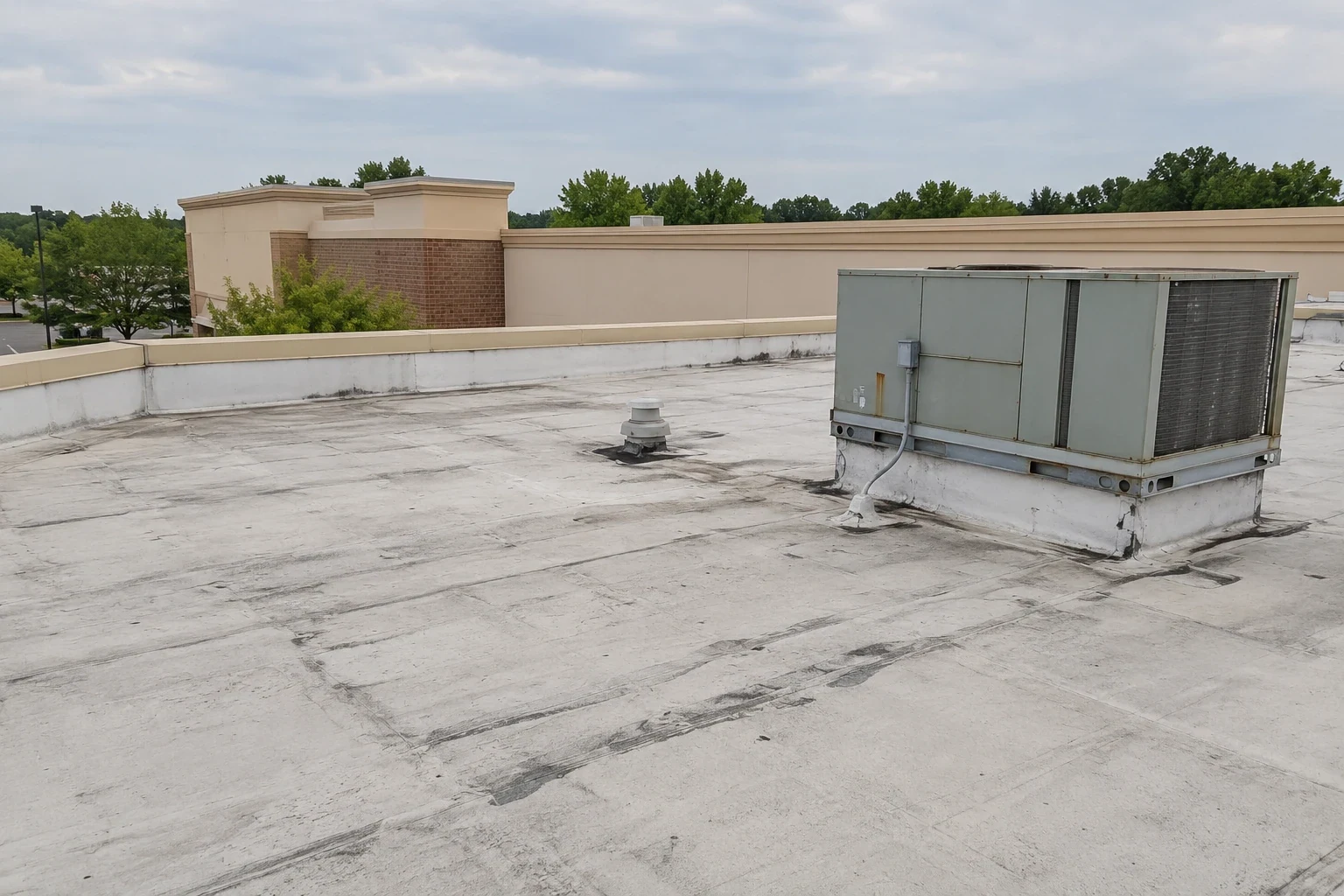
For flat roofs on gyms, cafeterias and additions, we pay close attention to ponding and to the details around rooftop units. Those sections often take the most foot traffic from technicians, and a worn path across a membrane is a leak waiting to happen. We add walk pads where the traffic goes and note them on the sketch, which is a low-cost step that protects the roof between replacements.
Warranty papers matter too. If a roof is still covered, a repair done the wrong way can void it. We read the warranty before any work, follow the maker's terms and keep a file of each visit. Districts that want a long view can build a multi-year plan, using roof capital planning to spread replacements across budget cycles instead of facing several in one year.
Procurement: bids, specs and clear scopes
Public work follows public rules. Districts usually bid roofing, and a clear scope makes bids comparable. We can help write one, listing the existing system, the target system, insulation requirements, flashing details, access limits and the schedule. A scope with a test cut, a drain count and a photo set draws tighter prices than one that says replace the roof.
The same discipline applies to public agencies of every kind, from city buildings to county facilities. The 2021 International Building Code and its State Fire Marshal amendments set the baseline in Arkansas, and the district's architect or engineer writes the specification that applies. We follow it and flag any place where the field condition calls for a change. A district that also runs buildings through a general contractor, on an addition or a renovation, can have us coordinate with that team so the roof work and the other trades share one schedule. For campuses in Springdale or Bentonville, the same approach holds.

Questions About School Districts
Commercial Roofing Questions
When should a district start planning a summer reroof?
Early in the winter before. Survey, scope, bid and order material by spring so crews can start the first week of summer. Late starts squeeze the schedule and raise the risk of finishing after students return.
Can roofing continue during the school year?
For repairs, yes, with controls. For a full reroof, it is better saved for summer. If a project must run during the year, we use sections, barriers, noise limits and a named contact for the principal.
What background checks do your crews have?
We follow whatever the district requires for visitors and contractors, and we supply a crew list ahead of the start. Anyone not cleared stays off the campus.
How do you handle a leak in a classroom?
We take emergency calls at any hour. First, we stop the water at the roof. Then we document the damage with photos so the district can handle the interior and the insurer.
Can you help us write a bid scope?
Yes. From us the district gets the roof survey, the existing build-up, drain and penetration counts and a short list of problem details. The formal specification stays with the district's architect or engineer.
Related Commercial Roofing Pages
Read how we handle this work in Fayetteville, AR
Read how we handle this work in Fayetteville, AR
Read how we handle this work in Fayetteville, AR
Read how we handle this work in Fayetteville, AR
Read how we handle this work in Fayetteville, AR
Read how we handle this work in Fayetteville, AR
Read how we handle this work in Fayetteville, AR
Read how we handle this work in Fayetteville, AR
