
Roofing for Real Estate Investors and REITs in Fayetteville, AR
Roof surveys, capital planning and repair-versus-replace pricing for investors and REIT owners holding commercial property in Fayetteville, AR.
An investor looking at a Northwest Arkansas building has one roof question before the offer: how much of the next five years of capital is sitting overhead. A seller's broker will say the roof is fine. A lender will want it in writing. The only way to answer is to put someone on the roof, record what is there and price the options, and that is the work we do for owners who buy, hold and sell commercial property in and around Fayetteville.
We write for the model, not for the brochure. Each finding comes with a photo, a location on the roof sketch and a cost driver, so the number you carry in the underwriting can be traced to something real.
Before the offer: what a roof survey should settle
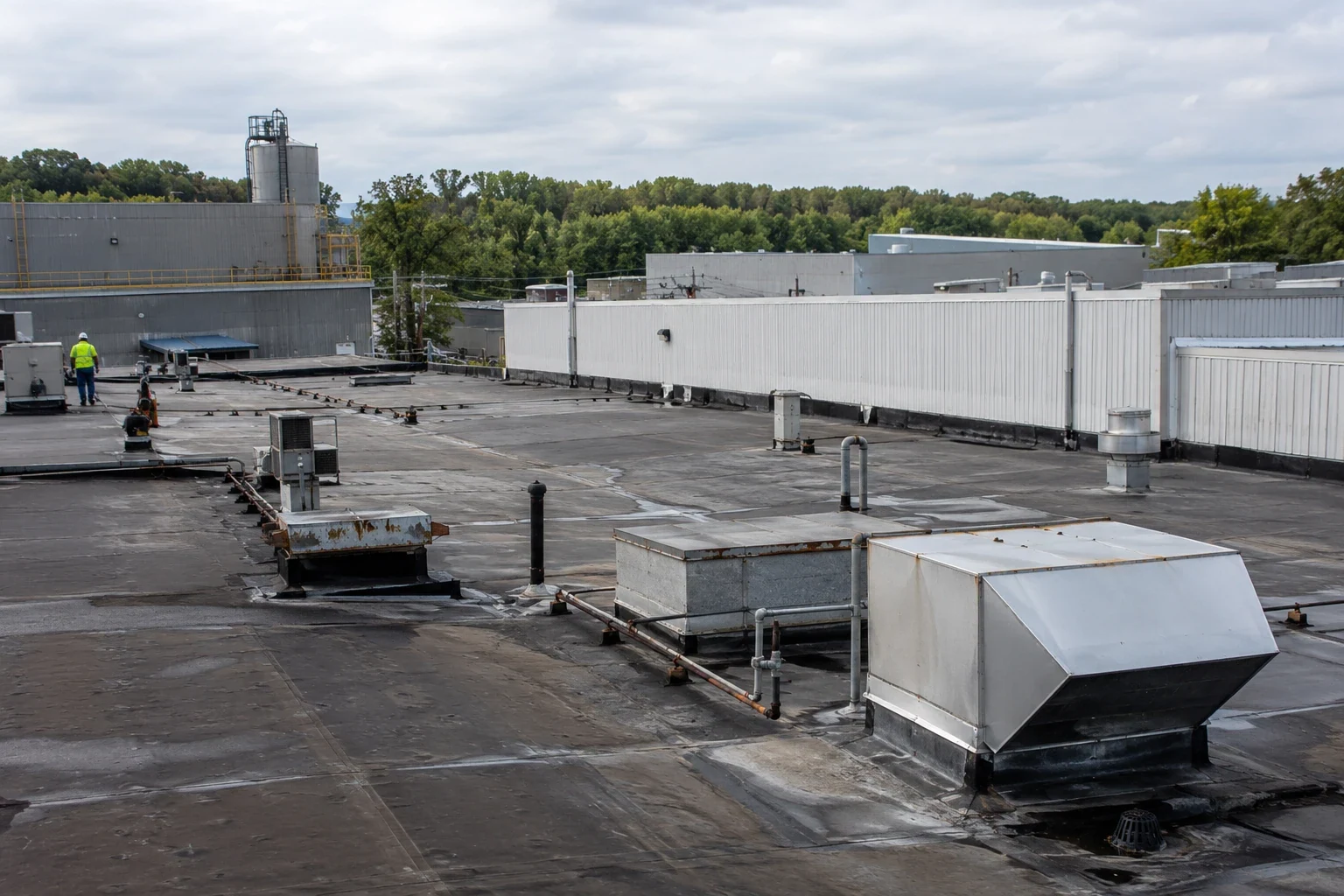
A quick look from the parking lot settles nothing. A due diligence roof survey walks the entire surface, probes for soft insulation, checks seams, flashings and drains, and notes every past repair. Where a question remains, a moisture scan or a core sample gives the answer, and the report says which findings are confirmed and which are visual.
You also get a rating by roof section: sound, repairable or near the end of its life. That lets you split the price between a deferred-maintenance credit and a capital reserve. Keep the closing calendar in mind, because a roof walk takes access, and access takes a few days of notice to the seller and the tenants. Tell us the deadline early, and we will work to it.
Tenants matter to the schedule as well. A roof walk on a leased building needs a call to the property manager, a time that does not clash with a busy shift and a key. If a tenant has reported leaks, we ask for those notes and photos, because they point to the sections worth the closest look. Where a building has several tenants, the property management company that runs it can supply the leak log.
Hold period: matching roof work to your plan
A five-year hold and a fifteen-year hold call for different roof decisions. On a short hold, the goal is usually to keep the roof dry, defer replacement and hand the buyer a clean record. A coating or targeted repair can serve that goal when the base is sound. On a long hold, the cost of repeated patching adds up, and replacing the system with better insulation can pay back through lower repair spend and a stronger lease story.
We lay out both paths in the same format so you can compare them, with the cost of waiting stated next to each. For roofs that qualify, roof coating restoration often fits a short hold, while a recover or replacement fits a long one. The decision is yours, and it should be made with the evidence on the table.
One more variable is the exit. A buyer's engineer will walk the same roof. If your file already holds a dated survey, photos of repairs and a clear record of any coating or recover, the buyer's questions are shorter and the roof is less likely to become a price chip late in the deal. That record costs little to keep and is worth building from the first year of ownership.
Older stock: what age tells you and what it does not
Northwest Arkansas Mall in Fayetteville opened in 1972, and the city's historic Square holds buildings from 1886 to 1911. A building's age tells you the era of its structure, not the age of its roof. Roofs get replaced, recovered and patched along the way, and it is common for a building to carry more than one layer. That is why we confirm the build-up with a probe or a core instead of reading it off the date on the deed.
The Fayetteville Industrial Park sits east of Fifteenth Street, and its buildings serve a different set of tenants from the Square. Each needs its own look. On a building with parapets, we check the coping runs and the original drains. On a building with a wide open field, we look at seams and ponding. We read what is overhead from the roof itself, not from the address.
Hail and rain: risks to carry in the model
One storm line crosses roofs of every age at once. In May 2020 hail up to 3.00 inches fell east of Fayetteville. Hail does not always leak at once. Bruised insulation can stay dry for a season and fail later, which is why we recommend a post-storm survey for any asset in the path, and a record you can give your insurer.
Rain adds its own load. Fayetteville averages close to 47 inches a year, so ponding at a drain or a failing seam gets tested every month. A deferred seam repair costs little today and a lot after the insulation is wet. We flag those items so they can go on a short-term maintenance plan instead of becoming a surprise in the asset review.
Insurance follows the same logic. If a storm damages a roof you own, the claim file starts with dated photos and a written description of the damage before any cleanup. Our records for an insurance restoration claim separate the storm damage from older wear, which keeps the claim from stalling on a dispute about what was already there.
Code and records: what changes with a reroof
Permit review in Arkansas runs on the 2021 International Building Code via the state fire prevention code, and the commercial energy entry still reads ASHRAE 90.1-2007. A reroof can bring insulation and permit requirements that a repair does not, so we check the local office before a price is final. In Fayetteville, in Lowell and elsewhere, the permit office has the last word.
Keep your roof file current. Warranty papers, invoices, survey reports and photos should live in one folder per asset, which is the point of roof asset management. When a buyer or lender asks, you can hand over the record in minutes instead of reconstructing it. Owners who also manage day-to-day operations through a property manager can share the same file.
Questions About Real Estate Investors and REITs
Commercial Roofing Questions
Can you survey a building before I own it?
Yes, with the seller's permission and a few days of notice. We coordinate access with the seller and the tenants so the walk does not disrupt operations, and we deliver the report on your closing schedule.
How do you separate deferred maintenance from capital replacement?
By section. A repairable area goes on the maintenance list with a price. A section that is saturated or failing across large areas goes on the capital list. The split gives you a negotiating basis and a reserve number.
Do you price both repair and replacement?
We do. Each report shows the repair path, the restore path and the replacement path with cost drivers and the likely consequences of waiting, so the comparison is clear.
What if the seller has no roof records?
Then we build the picture from the roof itself. A probe, a core and a moisture scan show what layers exist and how wet they are. The missing paperwork becomes a flagged item in the report.
Is hail damage visible after a few years?
Sometimes, as dents in metal, cracked coatings or soft spots, but bruising in insulation can stay hidden. A scan helps. If a storm is on record for the area, we recommend checking before you assume the roof is clean.
Related Commercial Roofing Pages
Read how we handle this work in Fayetteville, AR
Read how we handle this work in Fayetteville, AR
Read how we handle this work in Fayetteville, AR
Read how we handle this work in Fayetteville, AR
Read how we handle this work in Fayetteville, AR
Read how we handle this work in Fayetteville, AR
Read how we handle this work in Fayetteville, AR
