
Roofing for Healthcare Systems in Fayetteville, AR
Roof repair, replacement and planning for health systems with hospitals and clinics in Fayetteville, AR, with infection control and live floors in mind.
A hospital roof leaks into a place where leaks are not acceptable: an operating room, a pharmacy, a hallway that carries patients. A clinic roof leaks into exam rooms that have to close for the day. Either way, the facilities director gets the call, and the next question is what can be done tonight and what can wait for a planned shutdown. That is the decision we help a health system make.
Fayetteville's VA Medical Center and Washington Regional Medical Center, Springdale's Northwest Medical Center and Bentonville's Northwest Health System and Mercy are among the metro's larger health employers. Roofs on buildings like these carry demands that a warehouse roof does not, such as air intakes, live floors and rooms that cannot take a drip, and we plan for them from the first walk.
Infection control: dust, odor and what the crew brings in
Roof work above patient areas is an infection control question. Tear-off creates dust and debris, hot asphalt and some adhesives create odors, and air intakes on the roof can pull both into the building. Before any work begins, we ask the facility team to point out every intake, exhaust and relief vent on the roof, and we plan the sequence so that the most sensitive areas are protected first.
Many systems require an infection control risk assessment for work like this, and the facilities team usually leads it. We bring the roof side: which methods make the least dust, where to place temporary covers on intakes, how debris leaves the building and how the crew enters and exits. Cold-applied or mechanically attached systems can avoid some of the odors of torch or hot work, and we price them against the alternatives so the choice is made with the cost visible.
Always open: phasing the work around live floors
A health building does not close for a roof. We section the roof by what sits underneath, and we sequence the work so that the highest-risk areas get the shortest exposure. Noisy work goes to the hours the clinical team picks, which may mean nights or weekends. Material staging and dumpster placement are fixed in advance with security and facilities, so ambulance routes and patient entrances stay clear, and so any change in the plan goes through one named contact.
We also plan weather contingency in detail. A roof opened over a patient floor has to be closed in before the end of each work shift, with temporary seals ready and a person watching the sky. An occupied building reroof on a health campus rests on that kind of discipline, and on a clear line to the person who can say stop.
Security and access come into it too. Roofers moving through a health building need badges or an escort, a clean path to the roof hatch and a way to keep tools and material out of patient corridors. We bring a short list of crew names ahead of time and follow the building's sign-in rules. Hoisting is planned for hours when drop zones are clear of visitors, and a spotter watches the ground during every lift.
Rooftop systems: air handlers, exhaust and the curbs under them
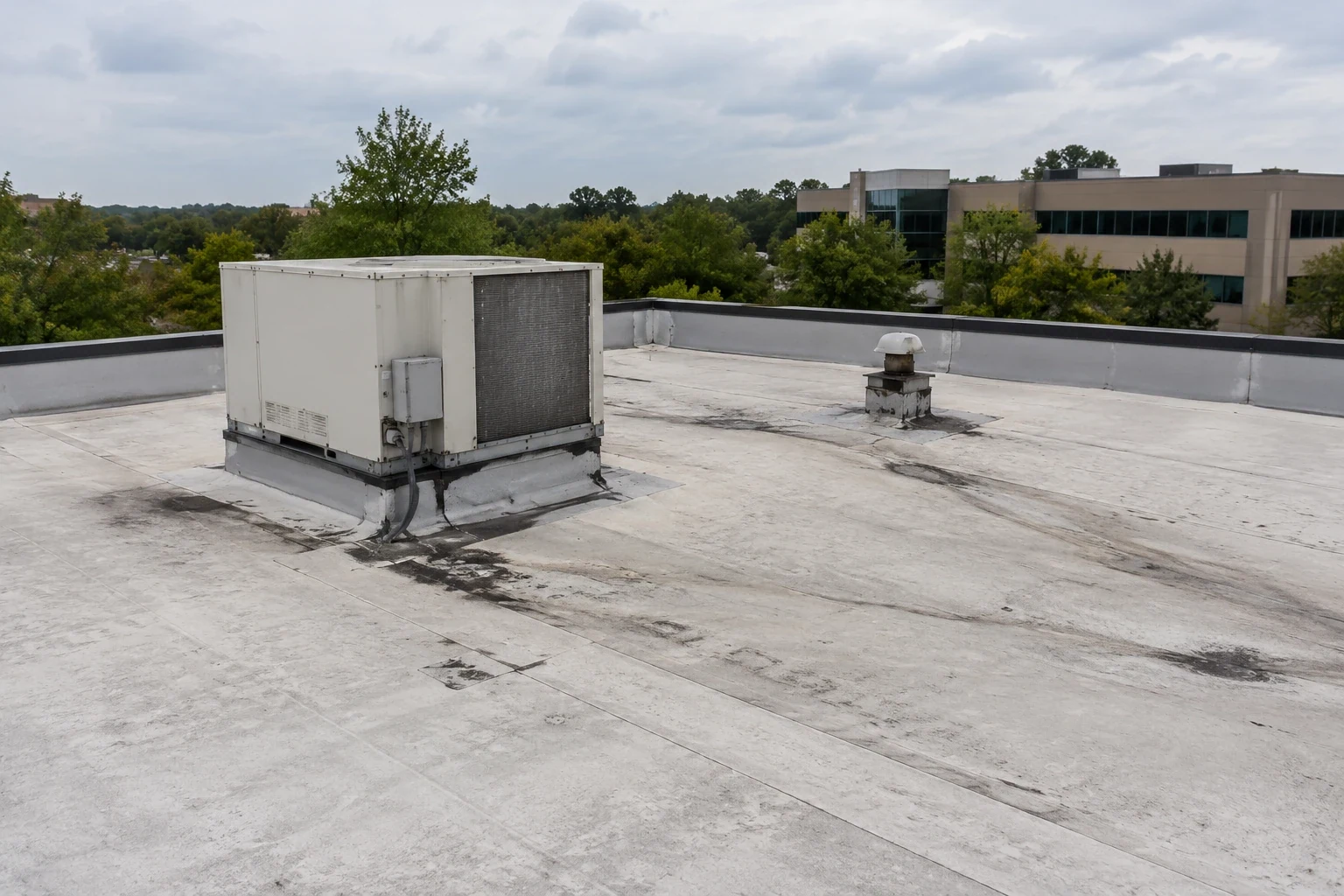
Health buildings carry a lot of rooftop equipment: air handlers, exhaust fans, chillers and dedicated units for operating rooms. Each sits on a curb or a support that is flashed into the roof. Those details are the usual place a leak begins, and moving a unit is a project in itself. We map every curb, check the flashing and sealants, and note which units cannot be shut down for work.
If equipment is due to be replaced soon, the roof plan should wait or be coordinated, because new units mean new penetrations. Raising rooftop equipment curbs and supports during a reroof gives water room to shed and lets the new membrane tie into a proper height. A coordinated schedule saves the cost of cutting into a brand-new roof. When a builder is already on site for an addition or a mechanical upgrade, we work through the general contractor so the roof sequence matches the other trades and no one walks across a finished membrane with heavy tools.
Storm weeks: hail, tornado wind and extreme cold
Hospitals have to keep running through the same weather that damages roofs. Hail as large as three inches fell east of Fayetteville in May 2020. Springdale's EF3 tornado of March 30, 2022 took out a large metal building near Highway 412 and ripped into a city shop at the airport. February 16, 2021 brought minus 20 F to Fayetteville, among the coldest readings Arkansas has recorded.
Each event stresses a roof differently: hail bruises insulation, wind lifts edges and cold opens seams and cracks sealants. After a storm, we walk the roofs of the health buildings in the path and report what is open, what is bruised and what can wait. For a facility that cannot lose a ceiling, a quick post-event check is a better use of an hour than waiting for a stain to appear. Our emergency roof repair line answers at any hour, holidays included.
Records: warranty files, surveys and the capital plan
A system with many buildings needs a roof record for each one. A roof asset management file holds the drawings, warranty papers, surveys, repair history and photos, so that capital planning rests on evidence. Then a manager can see which buildings have roofs near the end of life and which have time left, and can schedule replacements across several budget years instead of facing three at once.
We keep the survey format steady from year to year so trends are visible, and each new survey adds a dated page to the same file, so the history of any one roof reads at a glance without a search through old invoices. If a clinic in Rogers shows ponding that grows, or a roof in Fayetteville shows repeated seam repairs, the pattern shows up in the file. That helps the facilities team make a case for funds with something better than a stain on a ceiling. If an insurer is involved after a storm, our dated photos and written notes go straight into the file for the insurance restoration process, and they separate the storm damage from wear that was already present.
Questions About Healthcare Systems
Commercial Roofing Questions
Can you work with our infection control team?
Yes. We follow the plan your team sets, share the roof sequence and the method, and adjust to the controls you require. Work stops if a control is not in place, and it restarts only after your team confirms the fix.
Do you work nights and weekends?
When the clinical schedule calls for it, yes. Quiet hours are agreed in writing before the job, and we confirm the crew size and the noise level with your facilities lead.
What if a leak reaches a sterile area?
Call our emergency line right away. We stop the water at the roof, advise on temporary protection and document the path so the repair addresses the real entry point.
How do you protect air intakes during roofing?
We locate every intake first, then cover or relocate staging, choose low-dust methods and keep hot work away from them. Facilities signs off on the plan before we start.
Can we repair now and replace later?
Often. A targeted repair and a monitored schedule can bridge a roof to a planned replacement, as long as the insulation is dry and the repair is sound. We show both paths with their costs.
Related Commercial Roofing Pages
Read how we handle this work in Fayetteville, AR
Read how we handle this work in Fayetteville, AR
Read how we handle this work in Fayetteville, AR
Read how we handle this work in Fayetteville, AR
Read how we handle this work in Fayetteville, AR
Read how we handle this work in Fayetteville, AR
Read how we handle this work in Fayetteville, AR
Read how we handle this work in Fayetteville, AR
