
Distribution Center Roofing in Fayetteville, AR
Distribution and fulfillment center roofing in Fayetteville, AR: leak repair, recover and replacement for round-the-clock buildings, planned around trucks.
A distribution center has no quiet hour. Trailers back into the docks overnight, pickers work three shifts and the roof over them is expected to stay silent and dry through all of it. When a leak starts over a conveyor or a sorting line, the cost is not the repair. It is the minutes the line stands still. In Northwest Arkansas the freight moves along I-49/US 71, and the buildings that feed it cannot close for a roof.
In Fayetteville, AR we repair, recover and replace roofs on distribution and fulfillment buildings, and we plan every job around the dock schedule first and the weather second.
Neighbors in the building stock matter. A warehouse that stores goods on a single shift has more repair flexibility than a cross-dock that never stops, and a cold storage building adds condensation and ice to the list. We start by learning how the building runs, since the schedule shapes the plan more than the roof does.
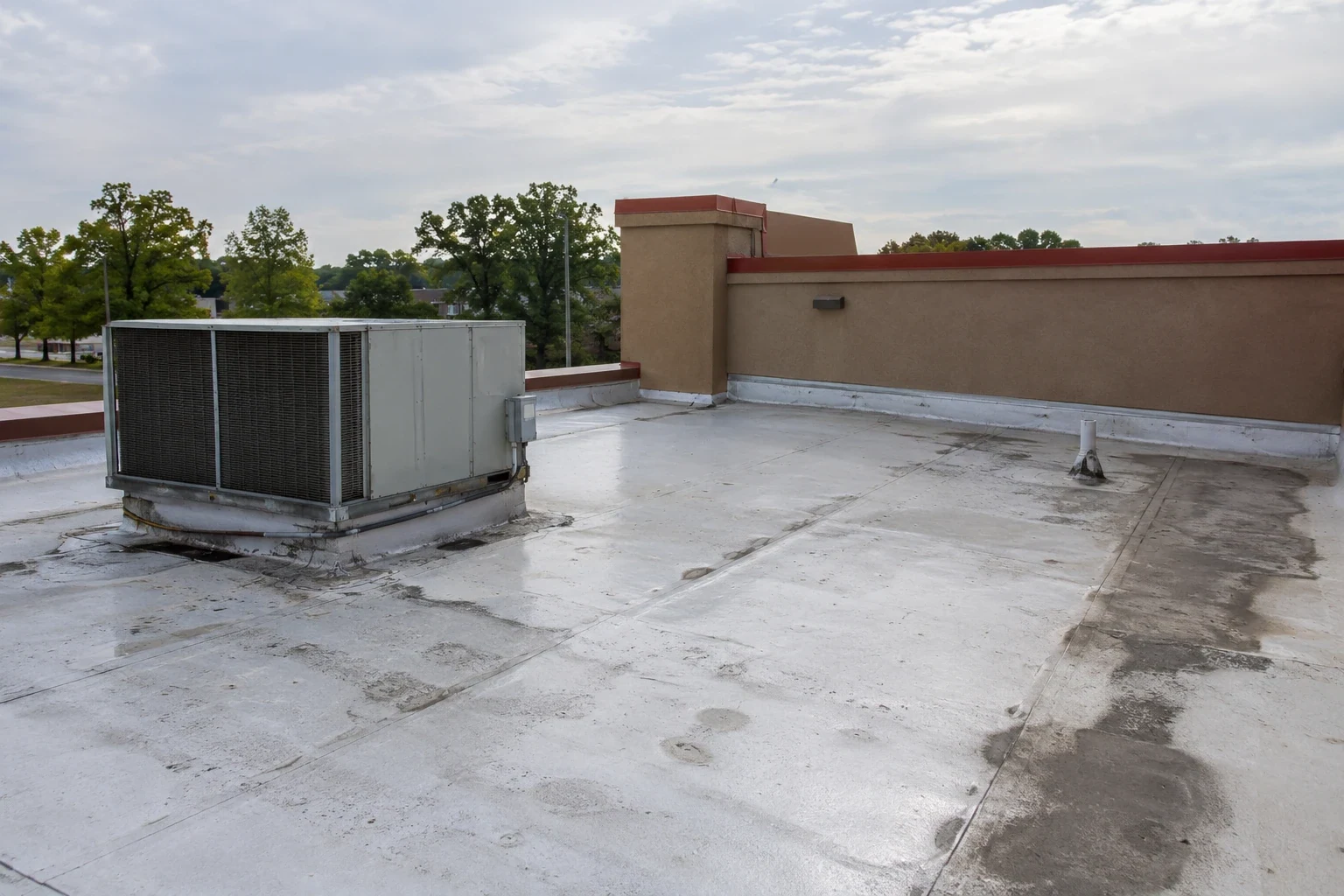
Roof types: big spans and many penetrations
Distribution buildings are wide, low-rise boxes with large roofs, and they usually carry a single-ply membrane, a metal roof or an older built-up system. Rooftop air handlers, exhaust fans, skylights and smoke vents add penetrations, and large buildings can have dozens. Each one is a flashing detail that wears.
A fulfillment building with a mezzanine or heavy conveyor loads under the deck adds another question: what the structure can carry. A recover adds weight, and a tear-off removes it, so the structural capacity belongs in the first conversation. We read the plans and test the deck before quoting either.
Curbs under rooftop units deserve a hard look. Large buildings carry large units, and the curbs move with thermal cycles, shed condensate onto the membrane and sit on flashing that was installed once and rarely reviewed. A failed curb flashing is a common source of a leak over a conveyor.
Tenant call: a leak over a live line
When the call comes, the first move is protection. We cover or divert the water, protect the equipment and give operations a plan for the affected area. Then we find the source, which on a large roof means a methodical sweep, a moisture scan and a drone pass for a first look.
Night and holiday calls get answered, and a distribution center does well to post the number at the dock office. A temporary repair stops the water; a permanent one follows when the area is dry. Dated photographs and a repair note go to the building file, so the cause and the fix are on record when the next shift supervisor asks.
Drone and infrared scans help here. On a roof this large, a drone pass in the morning shows ponding, displaced edge metal and obvious damage, and an infrared scan at dusk shows wet insulation by its heat signature. We follow up on the ground with a moisture probe before marking a repair area.
Cost of waiting: the money behind a stopped line
Delay costs more in a distribution building than in most. With 46.96 inches of yearly precipitation at Drake Field, spread over roughly 113 rainy days, a roof leaking into stored inventory builds a claim every storm. Wet insulation spreads the problem, and a small repair becomes a section replacement.
J.B. Hunt, headquartered in Lowell, runs a fleet counted at 12,000-plus trucks and 145,000-plus trailers and containers, which is why a distribution building nearby has little slack for downtime. We give the manager the repair cost, the cost of waiting and the replacement path side by side, with the likely service life of each.
Insurers also ask whether a loss was sudden or gradual. A clean maintenance record, dated photographs and a documented repair date help the operator show the difference, and a missing record can turn a covered claim into a dispute.
Storm week: hail, wind and spring tornado risk
Springdale's March 30, 2022 EF3 tornado, a 5.2-mile path of damage, is the regional reminder: it destroyed a large metal building near Highway 412 and ripped part of the roof off a city maintenance shop at the airport. Distribution buildings sit on open lots with big roofs and little shelter, and the spring storm line is their hardest season. The May 2020 hail in the NWS Tulsa log included 3.00-inch stones east-northeast of Fayetteville.
After a storm we check lifted edge metal, bruised membrane and displaced unit covers, then record each finding for the adjuster. A hail damage repair file with dated photographs and a roof plan speeds a claim, and a pre-storm report shows what changed.
Wind lifts edges and corners first, so we check perimeter trim, coping and flashing after every blow. Displaced rooftop unit panels are another common find, and an open panel is an open door for rain.
Docks and shifts: planning the work
Crane picks and hoist positions have to avoid dock aprons, trailer yards and fire lanes. We agree with operations on lift locations, on the hours when trucks are heaviest and on material deliveries timed for gaps in traffic. Highway 264 links I-49 to US 71B in Lowell, and we time deliveries so our trucks stay off the approach lanes.
Inside, racking, sprinkler lines and conveyors sit directly under the deck. We protect them with covers, sweep at day's end and keep fall protection around openings. An occupied-building reroof is staged in bays that dry in daily, so no section stays open overnight.
Delivery of material is its own scheduling puzzle. A tear-off generates debris that has to leave by chute or crane, and fresh material has to arrive and be staged on the roof without blocking lanes. We list each delivery with a time window and a route.
Questions About Distribution Center Roofing
Budget: portfolio planning for several buildings
Logistics owners and third-party operators often hold several buildings, and each has a roof with its own age and condition. A multi-site roof program puts them on one calendar with one report format. The result is a ranked list that tells finance which roof needs money first.
Large-roof replacements bring code review. Arkansas applies the 2021 International Building Code through the fire prevention code and lists ASHRAE 90.1-2007 for commercial energy, and the building official confirms the insulation level before pricing. Owners near Lowell, Springdale and Fayetteville Industrial Park get the same format.
Commercial Roofing Questions
Can the roof be replaced without stopping the building?
Yes, in sections. We work bay by bay, dry in each section the same day and protect the space below. Operations agrees on the work area, the hoist location and the hours of noisy work before we start.
What does a recover add in weight, and does the structure allow it?
A recover adds a membrane and often a cover board over the old roof. Structural capacity depends on the deck, the framing and the loads below. We review plans and test the deck before quoting a recover.
How do we handle a leak above racking?
Cover the inventory, divert the water and call for emergency response. We find the source, make a temporary repair and plan the permanent one. The note we leave documents the cause.
Why do multi-building owners want a single report format?
It lets finance rank roofs by condition, age and cost, and it makes budget decisions simple. We use one format across buildings so comparisons are fair.
What records help with an inventory claim after a leak?
Dated photographs of the roof and the damage, a roof plan with the leak location marked and a written cause. We prepare those at the time of the repair.
Related Commercial Roofing Pages
Read how we handle this work in Fayetteville, AR
Read how we handle this work in Fayetteville, AR
Read how we handle this work in Fayetteville, AR
Read how we handle this work in Fayetteville, AR
Read how we handle this work in Fayetteville, AR
Read how we handle this work in Fayetteville, AR
Read how we handle this work in Fayetteville, AR
Read how we handle this work in Fayetteville, AR
