Hospital Roofing in Fayetteville, AR
Hospital and healthcare campus roofing in Fayetteville, AR: infection-aware work plans, controlled access and phased repair and replacement.
A hospital roof is not one roof. It is a patchwork of tower roofs, wing roofs, penthouse roofs, canopies and low additions put on over several building campaigns, each with its own age, material and drainage. The facilities director who inherits that patchwork is asked to keep every section dry while operations continue at all hours and infection control watches the dust. A leak over an operating suite, a pharmacy or a patient room is a clinical event, not a work order.
In Fayetteville, AR we inspect, repair and replace roofs on hospitals and healthcare campuses, and we plan the work as phases a facilities team can live with.
The patchwork is also a records problem. Roof files are scattered across contractors, years and departments, and a repair done on a Sunday night may exist only in a work order. The first job on a campus is to build one map and one file, and every later decision is easier for it.
Roof types: a campus of different roofs
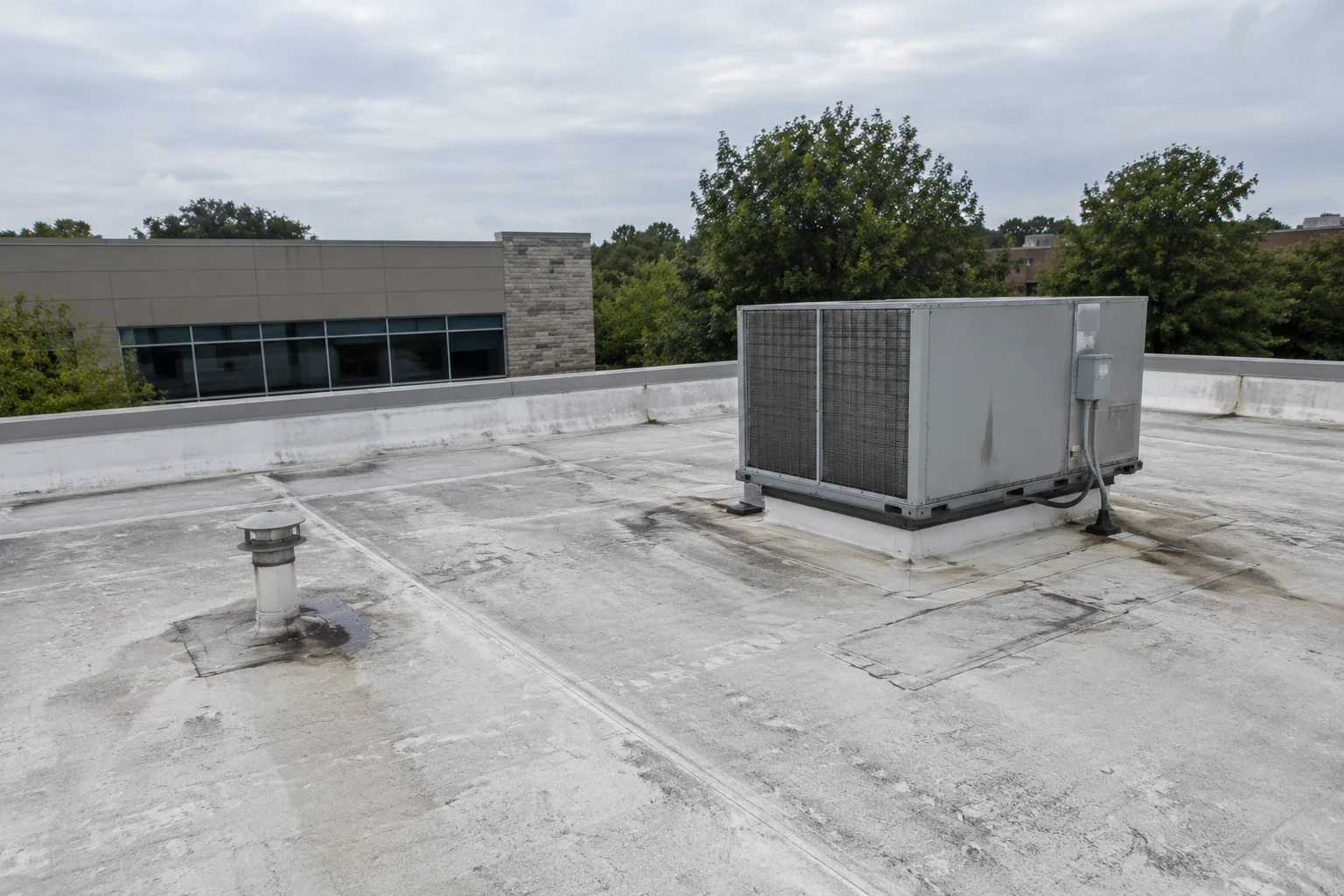
Fayetteville's largest employers include Washington Regional Medical Center and the VA Medical Center, Springdale's include Northwest Medical Center-Springdale, and Bentonville's include Northwest Health System and Mercy. Healthcare campuses tend to grow in stages, and the roofs can show it: single-ply membranes on one wing, modified bitumen on another, metal on a canopy, with penthouses and equipment platforms between.
Each roof type needs its own repair. A modified bitumen section fails differently from a single ply, and a canopy roof drains differently from a tower. We build a roof plan that marks every section by type, age and last repair, and that map guides every later decision.
Rooftop equipment on a hospital is heavy and critical: air handlers that supply operating rooms, exhaust for labs, generators' stacks and chillers. Each one sits on a curb or platform with flashing that must stay tight for years. We inspect them on every walk and report the condition of each curb, since a failed flashing at an air handler can send water straight into a duct.
Facilities call: water over a clinical space
The call goes to facilities first, and the first step is protection of patients, staff and equipment. We respond quickly with a plan for sealing or diverting the water, and we coordinate with infection control and safety on interior work. Then we find the source, which on a campus roof means tracing across penetrations, expansion joints, drains and wall flashings.
Written documentation matters. We give facilities a dated note with photographs, the cause, the repair and the drying confirmation. It supports compliance files, insurance claims and the conversation with clinical leadership about whether a space can be returned to use.
Pharmacies, sterile processing and surgical suites get special handling. They run under pressure and humidity limits, and water above them can force a shutdown that cascades through the schedule. We mark those rooms on the roof plan and treat the roof above them as the highest priority for inspection.
Cost of waiting: mold, downtime and renewal
Drake Field logs 46.96 inches of precipitation in a year on about 113 days of rain, and a weak spot on a hospital roof is tested each time. A leak that reaches ceilings can trigger mold remediation and closure of a space, and the cost is more than the repair. A small repair done early costs far less than an emergency during a storm line.
We give the facilities director three numbers: repair now, repair and plan, and replace. The comparison shows what each year of delay is likely to add, and it can be placed in the capital request. A moisture survey before a project begins shows whether insulation is wet, which changes the scope.
Mechanical rooms and passenger-lift machine rooms sit under roofs as well, and water there can stop a building that cannot afford to stop. A roof leak above a switchgear room is the case a facilities team plans against, and a periodic check of that roof is cheap insurance.
Storm week: hail, wind and tornado risk
Seven people were injured when Springdale's EF3 tornado of March 30, 2022 crossed the city, and its estimated peak wind was 145 mph. Hail in the May 2020 NWS Tulsa log reached 3.00 inches east-northeast of Fayetteville. Hospitals plan for severe weather, and the roof is part of that plan.
After a storm we walk the roof for lifted edges, bruised membrane, displaced equipment covers and debris against curbs. A wind damage repair done at once prevents a second event, and dated photographs support the claim. Emergency response is available around the clock, which matters on a campus that never closes.
Access and infection control: how the crew works
Hospitals control who goes where. A crew needs badging, orientation, an escort or a defined route, and a plan for materials. Infection control may require negative air, sealed barriers, dust monitoring and cleaning protocols for any work near the building envelope. We ask for these rules at the start and put lead times in the schedule.
Noise, odor and vibration affect patients and equipment. Adhesives and solvents can enter air intakes, so we locate intakes before the roof opens and cover or avoid them. An occupied-building reroof on a hospital is phased by wing, with each section dried in daily and every phase tied to a facilities sign-off.
Emergency access cannot be blocked. Ambulance routes, helipad approaches where they exist and fire lanes stay clear at all times, and delivery windows are set with security. A crane lift over a drive is scheduled for the quietest hour and watched by a spotter.
Questions About Hospital Roofing
Budget: phased capital plans for campuses
A hospital roof program is a multi-year plan. A capital plan ranks each roof section by condition and cost, splits replacement into phases and fits the phases into budget years. A roof condition report for each wing provides the base data.
Campus projects are reviewed against the 2021 International Building Code, which Arkansas adopted through its fire prevention code in January 2023, and the ASHRAE 90.1-2007 energy listing, with the building official confirming insulation by phase. Systems with campuses in Springdale and Bentonville can use one format across sites, and the same phased approach carries over to a medical office or a school.
Each phase closes with a punch list walked jointly by the crew and facilities, so that a section is accepted before the next opens.
Commercial Roofing Questions
How is a hospital reroof phased?
By wing and by roof section, with each phase tied to a facilities sign-off and a daily dry-in. Infection control requirements and access rules are set before the first phase starts.
What happens to dust and odors near air intakes?
We locate intakes first and cover or avoid them. Barriers and cleaning protocols follow infection control's plan, and adhesives and solvents are chosen to suit.
How do we find the source of a leak on a campus roof?
We trace from the interior stain along the deck to the nearest penetration, expansion joint, wall or drain, and confirm with a moisture scan. The written note records the cause and repair.
Can a roof be repaired during a storm week?
Temporary repairs can be made quickly, and permanent work is scheduled for dry days. We respond around the clock and document the work for the claim.
What does a facilities director need for a capital request?
A roof plan, condition report, likely service life for each section and a cost range for repair and replacement. We prepare that package.
Related Commercial Roofing Pages
Read how we handle this work in Fayetteville, AR
Read how we handle this work in Fayetteville, AR
Read how we handle this work in Fayetteville, AR
Read how we handle this work in Fayetteville, AR
Read how we handle this work in Fayetteville, AR
Read how we handle this work in Fayetteville, AR
Read how we handle this work in Fayetteville, AR
Read how we handle this work in Fayetteville, AR