Rooftop Equipment Curbs and Supports in Fayetteville, AR
Curb flashing, unit supports and pipe stands for commercial rooftops in Fayetteville, AR, with hail, freeze-thaw and unit changeouts planned and priced.
The work order says unit 6, northeast corner, drip on the second hallway tile, and the property manager has already been told the roof is fine. In a case like that the roof usually is fine, out in the open. The problem is a curb: a frame that was flashed years ago, reflashed by whoever came next, and now sealed with a bead that has dried to powder.
Every unit, vent, fan and pipe stand on a roof is a place where the membrane stops and something else begins. In Fayetteville, AR, where the year brings large hail, a freeze-and-thaw week or two and steady rain, those places carry most of the leak risk. We treat them as a group, count them, rate them and price the work so a manager can see the whole list.
Count: the inventory comes before the quote
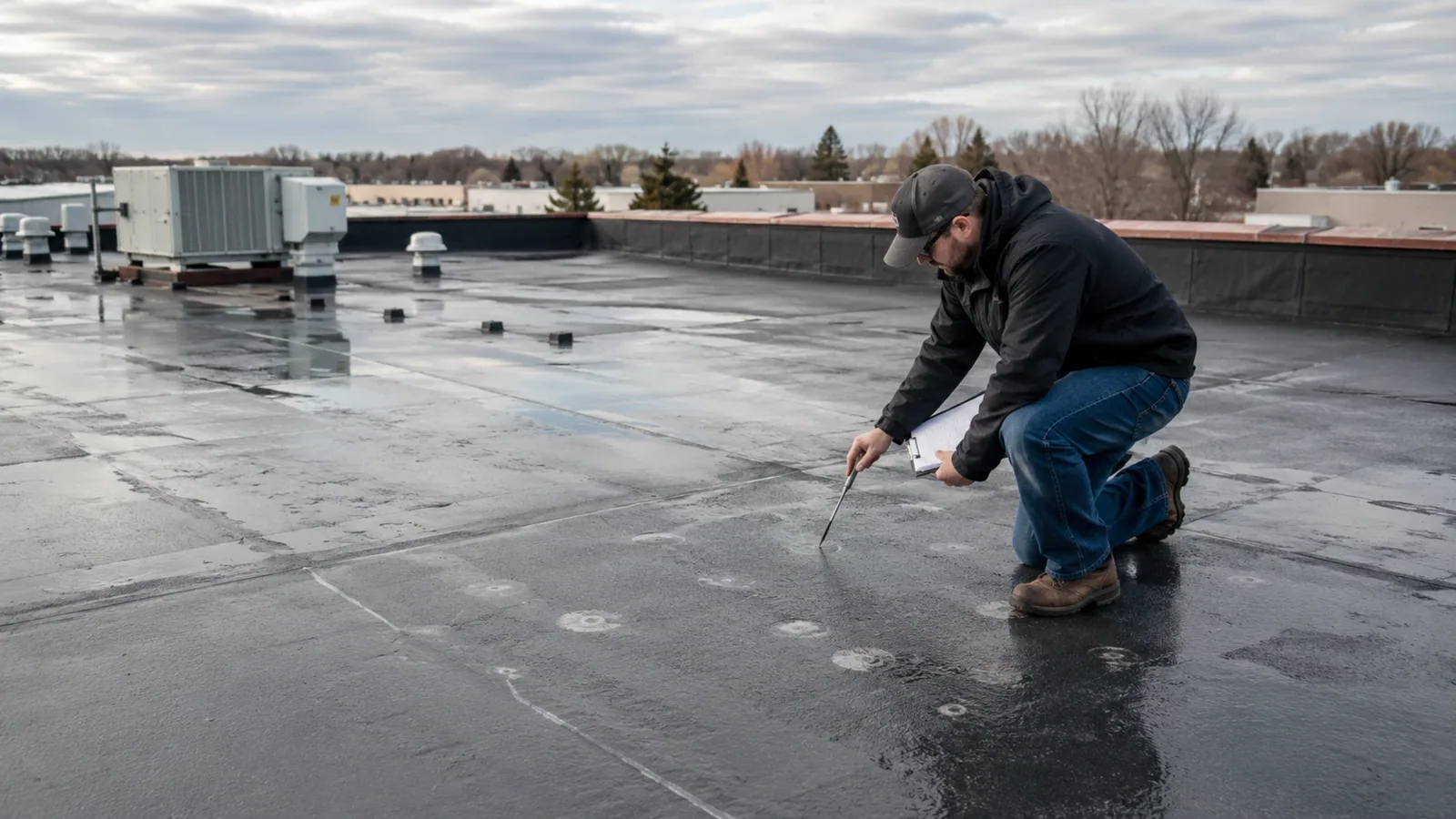
We begin by walking the roof and listing every piece of equipment and every support: units, curbs, rails, pipe stands, conduit runs, exhaust fans, hatches and abandoned stubs. Each gets a number, a photograph and a condition rating. The total is often longer than the roof plan suggests, because rooftops collect equipment over the years and the plan rarely keeps up.
A numbered inventory does three jobs. It shows which curbs to fix first, it lets a manager answer a tenant call by number, and it prevents the same defect from being quoted twice. It also catches equipment that no one is using any more. Removing a dead unit and patching the roof is cheaper than repairing its curb for ten more years, and the savings show up on the list.
Flashing: where curbs usually fail
A curb is a raised frame that lifts a unit clear of the roof surface, with the membrane turned up its sides and capped by counterflashing or a metal pan. It fails at the corners, where the membrane was folded and has since stretched; at the cap, where sealant has dried and split; and at the base, where the membrane has pulled away from the frame. Water then runs behind the flashing and down the inside of the curb.
Hands go along the turned-up membrane to find hollow spots, and we measure flashing height and probe the sealant. A repair that replaces the base flashing and ties into dry membrane lasts; a smear of mastic does not. Where flashing keeps failing at the same corner, the cause is often movement, and the fix includes a stronger attachment. A flashing failure repair at a curb carries the new work onto clean, sound roof.
Hail: units, panels and the roof around them
May 2020 storm data lists 3.00-inch hail near Fayetteville, with 2.50-inch and 1.75-inch reports as well. Hail dents unit housings and condenser coils, cracks plastic caps and bruises the membrane beside the equipment where debris and ice collect. A unit that looks fine from the ground can be shedding water onto a damaged sheet below it.
After a hail report we walk the equipment and inspect the roof around each unit as well as the unit. Damage to coils and housings is for the mechanical contractor, but the membrane, curb and flashing are ours to document. A hail damage record that includes the equipment areas is useful for a claim, and it shows which curbs need attention before the next storm line. Timing matters here: curb work done in October or April costs a fraction of the same work done in a storm week, when mobilization is rushed and the roof below is already wet.
Pipes and supports: protecting the sheet from its own equipment
Condensate lines, refrigerant lines, gas pipes and conduit cross the roof on supports, and loose blocks slide and grind through the membrane. A line that sags between supports collects water and drips on one spot. A pipe that discharges onto bare membrane stains it and wears a path. In freeze-and-thaw weeks, water left in a low point of a line freezes and can split the pipe or push a support off its base.
We replace loose blocks with stands that spread the load, add a protection pad under each foot, re-pitch lines so they drain and extend condensate runs to a drain or a splash pad. Roughly 10 days a year with freezing highs are enough to do that damage. Where equipment is dense, a commercial roof repair that handles the supports along with the curbs avoids a second trip.
Changeouts: scheduling the roof with the unit
Swapping a unit leaves a hole in the roof. The old unit comes out, the curb is open to the building and the weather does what it likes. The plan has to settle who disconnects, when the opening is covered, what temporary protection stays if the new unit is late and who closes the flashing once the new unit lands. A spring storm line does not wait for a delivery date.
New units rarely match old curbs in footprint, weight or duct position, so the new dimensions are checked, the curb is adapted or replaced and flashing height is confirmed. Doing the curb work with the changeout is cheaper than a return visit, since the area is clear. On an occupied building, a phased work plan covers the rooms below while the unit is swapped. The quote shows the curb work as its own line, tied to the mechanical contractor's schedule, so the roof and the equipment trade are never waiting on each other.
Questions About Rooftop Equipment Curbs and Supports
Local: large single-level buildings, many units
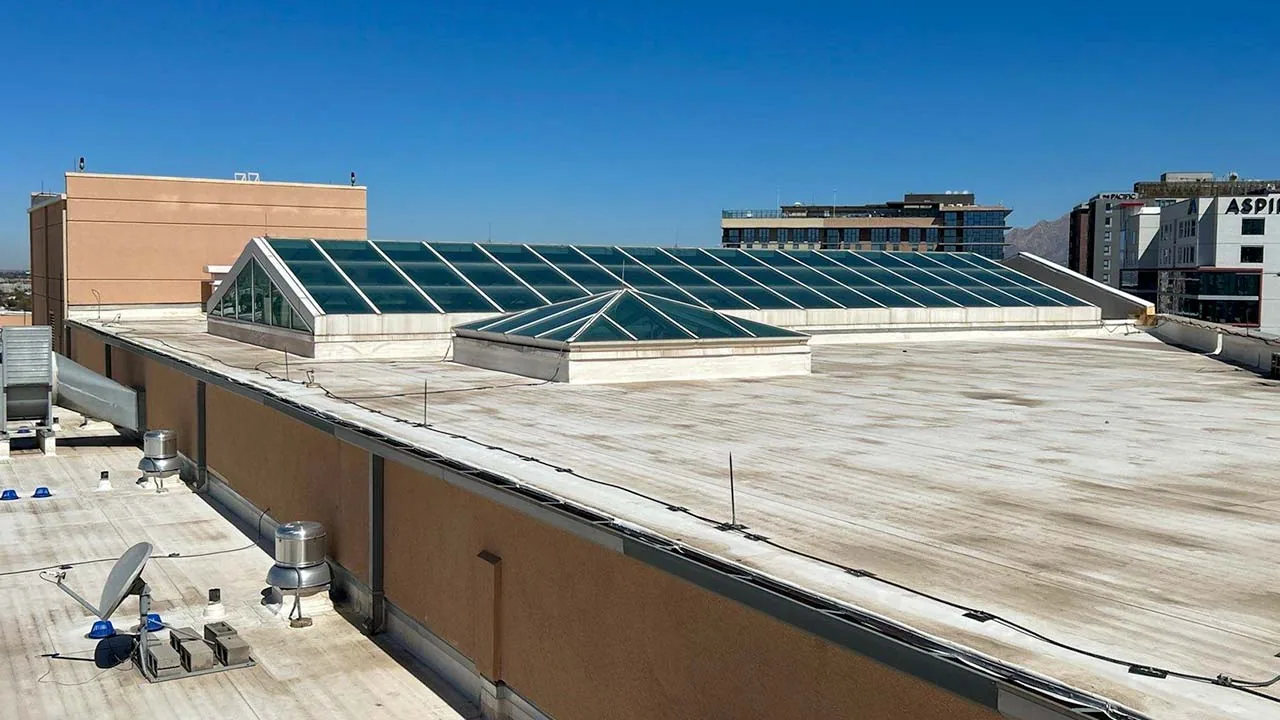
Uptown Fayetteville's mall opened in 1972 and went through a 1995-1999 expansion. A roof that carries many units can have many curbs to keep dry, and a roof with twenty curbs and a roof with two are different budgets, so we count them before we say anything about the mall's roof or any other. The count comes first because every other line of the quote follows from it.
For owners in Pinnacle Hills, Uptown Fayetteville and Fayetteville, the equipment inventory is the first deliverable. It shows how many curbs, supports and pipe runs the roof carries and which are at risk, and it turns a flood of small tenant calls into a planned list with prices. Where a unit is near the end of its life, we flag it, since the cheapest time to rebuild its curb is the day the unit is replaced.
Commercial Roofing Questions
Can a leaking curb be fixed without lifting the unit?
Sometimes. A split cap or a dried sealant bead is reachable with the unit set in place. Failed base flashing, a wet curb interior or a frame that has shifted calls for lifting the unit, so new flashing can run down to sound membrane.
How tall should a curb be?
Tall enough that water ponding beside it cannot reach the top of the flashing. Manufacturers set a minimum, and on a roof that holds water we aim higher.
Who disconnects the unit during a changeout?
The mechanical and electrical trades. We handle the curb, flashing and dry-in and schedule our work around theirs so the opening is never left uncovered overnight.
Should we remove abandoned equipment?
Yes, in most cases. Removing a dead unit or pipe and patching the roof eliminates a leak point and costs less than maintaining the curb for years.
What does a pipe support do for the roof?
It lifts the line clear of the membrane and spreads the load, so wind and temperature cannot grind the pipe through the sheet. Loose blocks do the opposite.
Related Commercial Roofing Pages
Read how we handle this work in Fayetteville, AR
Read how we handle this work in Fayetteville, AR
Read how we handle this work in Fayetteville, AR
Read how we handle this work in Fayetteville, AR
Read how we handle this work in Fayetteville, AR
Read how we handle this work in Fayetteville, AR
Read how we handle this work in Fayetteville, AR