Self-Storage Roofing in Fayetteville, AR
Self-storage roofing in Fayetteville, AR: exposed-fastener metal panel repair, leak response over customer units and phased reroofs across long row buildings.
A storage facility manager hears about the roof from a customer. Someone opens a unit and finds a wet box on the floor, a stained mattress or a puddle under the door. The unit rents for a modest monthly fee, but the contents may be worth far more, and the customer wants to know who pays. In Fayetteville, AR a self-storage owner with a roof plan, a repair log and a photograph of each building can answer that call in minutes, and keep a small leak from becoming a claim.
Metal panels: the roof most storage buildings carry
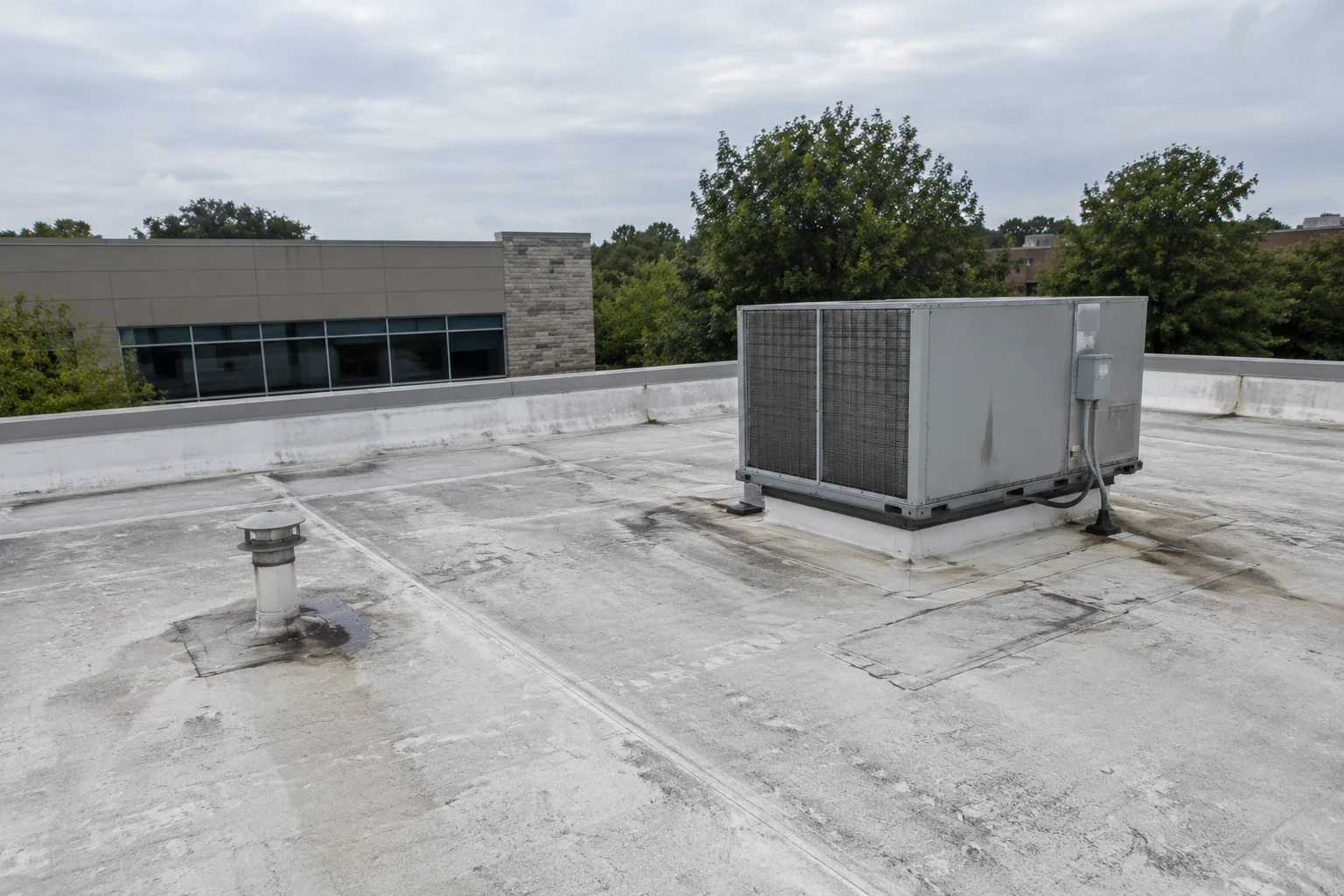
Many storage buildings are long, low rows with metal roof panels over open framing or a thin deck. The panels are fastened with exposed screws that have rubber washers, and over time the washers dry out, the screws back out as the metal expands and contracts, and the holes widen. A drip appears at one unit and the next heavy rain finds more.
The first repair is a walk of the full roof to check every fastener line. Loose screws are replaced with oversize screws or new ones with fresh washers, and laps and ridge caps are resealed with a compatible sealant. Panels that have rusted or split are replaced in sections. We also look at the transitions where a lower roof meets a taller wall, at the gutters and downspouts that carry water off a long run, and at any skylight panels that were added over a drive aisle. Each is a separate line on the repair list, with its own cost, so the owner can approve the urgent items and hold the rest. Where the roof is nearing the end of its life, a metal roof retrofit or a coating can add years without tearing off the panels, and the owner sees the price of each choice side by side.
Leak response: from customer call to dry unit
When a customer calls, the first step is to log the unit number, the building, and when the water appeared. The manager sends us photographs, and we find the roof area above the unit. Storage roofs are often one large plane, so water can run a long way before it drips. We trace it up the slope, check every fastener, lap and penetration, and fix the entry.
A same-day dry-in with sealant or a temporary patch stops the loss. The permanent repair follows when the roof is dry. We write each repair on a building map, so the next call about the same unit can be matched to earlier work. That log also helps with disputes, and with the owner's own planning, since three calls from the same building in one season point to a roof that needs more than patches. If a customer claims damage, the manager can show the date of the leak, the time of the repair and the photographs. Our commercial roof leak repair method follows this order.
Growth corridors: where new storage buildings go up
Self-storage follows housing. Cave Springs grew from 1,729 residents in 2010 to 5,495 in 2020, Tontitown had 4,301 in 2020 and a 2025 estimate of 8,046, and the metro has seen growth and building around Johnson, which has an I-49 exit at Exit 69. Storage owners near US 412, I-49 and Highway 112 are working in towns that are adding homes, and the roofs they build or buy need a plan from the start.
New facilities have new roofs, and owners sometimes skip inspection until a leak appears. A first-year inspection catches installation issues, such as missed fasteners, damaged panels and unsealed laps, while the builder is still responsible. Older facilities need a plan before the washers fail. We inspect both and give the owner a ranked list by building. The same method applies to a flex industrial building and other long, low roofs.
Wind: why edges and ridges matter on a row building
On March 30, 2022 an EF3 tornado struck Springdale with estimated peak winds of 145 mph, and it destroyed a large metal building near Highway 412. Few storage buildings face winds like that, but ordinary thunderstorm winds still lift edges. A long metal roof catches wind at the eaves and the gable ends, and a loose rake trim can peel a panel back.
We check the roof perimeter first: the fasteners at the eave, the ridge cap, the rake and the corner trim. Loose trim is refastened and sealed. If a panel has lifted, we repair it and check the purlins under it. After a storm, a quick walk of each building catches problems before the next rain. Our wind damage repair work starts with the edges.
Hail: dents, leaks and customer claims
Hail of up to 3.00 inches was reported about a mile east-northeast of Fayetteville in May 2020. On a metal roof, hail dents panels and may crack sealant at the fasteners. Dents alone do not always leak, but they can break the coating and shorten the life of the panel. A claim file helps. We photograph the dents, measure their size and count them per panel on a sample slope.
That information supports the insurance claim and the adjuster visit. For a facility with many buildings, we map which buildings are hit hardest, so the owner can focus on the roofs that matter. If water is entering units, a temporary dry-in goes on those first. Condensation is a separate issue, and one that shows up on new buildings: a metal roof over cool contents can drip when warm air meets cold panels, and we check for that before assuming a leak.
Questions About Self-Storage Roofing
Maintenance and budget: a low-cost routine
A twice-a-year walk of every roof, with a fastener check and a drain clean-out, costs a small fraction of a major repair. Timing matters: the spring walk comes before the March to May storm stretch, and the fall walk comes before the first hard freeze, when leaves clog gutters and ice loads the edges. We log the results by building, so the owner sees which roofs are aging fastest. A reserve line for roofs, set by age, keeps the budget stable. For owners with sites in Fayetteville and nearby towns, one report format covers every location, and a simple preventive maintenance plan keeps the work on schedule. A larger warehouse follows the same routine.
Commercial Roofing Questions
How often should storage roofs be inspected?
Twice a year works well: once in early spring before the storm season and once in the fall before freeze. After any hail or high-wind event, walk the roofs again. A short written log per building keeps the pattern visible.
Who pays when a leak ruins a customer's belongings?
Your rental agreement and insurance answer that, and the owner reads them. A dated record of roof inspections, repairs and photographs helps in any dispute, and we supply the roof side of that record.
Can screws be replaced without removing the panels?
Yes. Back-out screws are replaced with oversize screws or new ones with fresh washers, and laps are resealed. This is a low-cost repair that extends the life of a sound roof. Rusted or split panels need replacement.
Is a coating worth it over an old metal roof?
On a roof with sound panels and tight fasteners, a coating can seal and extend life. It does not fix loose screws or rusted panels, so repair comes first. We check the roof and price both steps.
Why do some units drip when the roof is not leaking?
Condensation forms when warm moist air meets cold metal. It can look like a leak. Ventilation, insulation under the panel and a vapor layer reduce it. We check the pattern of drips against the weather before repairing.
Related Commercial Roofing Pages
Read how we handle this work in Fayetteville, AR
Read how we handle this work in Fayetteville, AR
Read how we handle this work in Fayetteville, AR
Read how we handle this work in Fayetteville, AR
Read how we handle this work in Fayetteville, AR
Read how we handle this work in Fayetteville, AR
Read how we handle this work in Fayetteville, AR
Read how we handle this work in Fayetteville, AR