Seam Failure Repair in Fayetteville, AR
Repair split, open and lifted seams on commercial roof membranes in Fayetteville, AR, with probe testing, welded or taped fixes and a priced list by location.
A seam is the one place on a flat roof where two pieces of membrane are asked to act as one. Welded, glued or taped, it carries the weight of rain, heat, foot traffic and a few hundred freeze-and-thaw cycles. When it fails, the tenant gets a drip and the property manager gets a call. A seam that opens a quarter inch in March may be six inches by July if nobody looks.
Seam trouble is common and fixable. The question is whether a failure is a local fault or a sign of a roof that is giving out. We answer by testing the seams, mapping what we find and giving a repair that matches the cause, with a price beside each item.
Finding failures: probes, pulls and what a bad seam looks like
A seam can fail without showing a gap. We run a blunt probe along every seam, feeling for soft or unwelded spots. On thermoplastic roofs, a good weld resists the probe and leaves a clean bead at the edge. A bad weld lifts, shows a dull or dirty line, or lets the probe slide in. On adhered or taped seams, we look for lifted edges, wrinkles and dirt under the lap.
Where the seam looks marginal, we cut a small test sample and pull it apart. A weld that peels cleanly at the interface was never fully fused. A weld that tears the membrane is sound. We mark each failed seam on the sketch with its length and type, so the repair price is based on measured footage. A walk that finds all the failures in one pass saves the owner several smaller calls.
Seams meet other details at their ends, and those junctions need their own check. Where a seam runs into a wall, a curb or a pipe, the flashing and the seam have to tie together. A T-joint, where three layers of membrane meet, is the toughest spot to weld. We look at each one for gaps, wrinkles and open corners, and we treat flashing failure and seam failure as a pair when they meet.
Causes: why seams open in Northwest Arkansas
Heat is a large factor. July highs average 88.7 F at Drake Field, and highs above 100 F occur about three times a year. Dark membranes run hotter than the air, and seams expand and contract with the daily swing. Add the winter side, about ten days a year with highs below freezing and 6.5 inches of snow, and the seams are under stress at the cold end as well as the hot one.
Other causes are closer to the roof. Dirt or moisture on the surfaces at install can prevent a full weld. Ponding water attacks seams in low areas. Foot traffic around equipment wears them. Poor lap width or rushed work leaves weak spots. A ponding water repair may be needed along with the seam fix, or the seam will open again in the same place.
Repair methods: weld, tape, cover strip or re-adhere
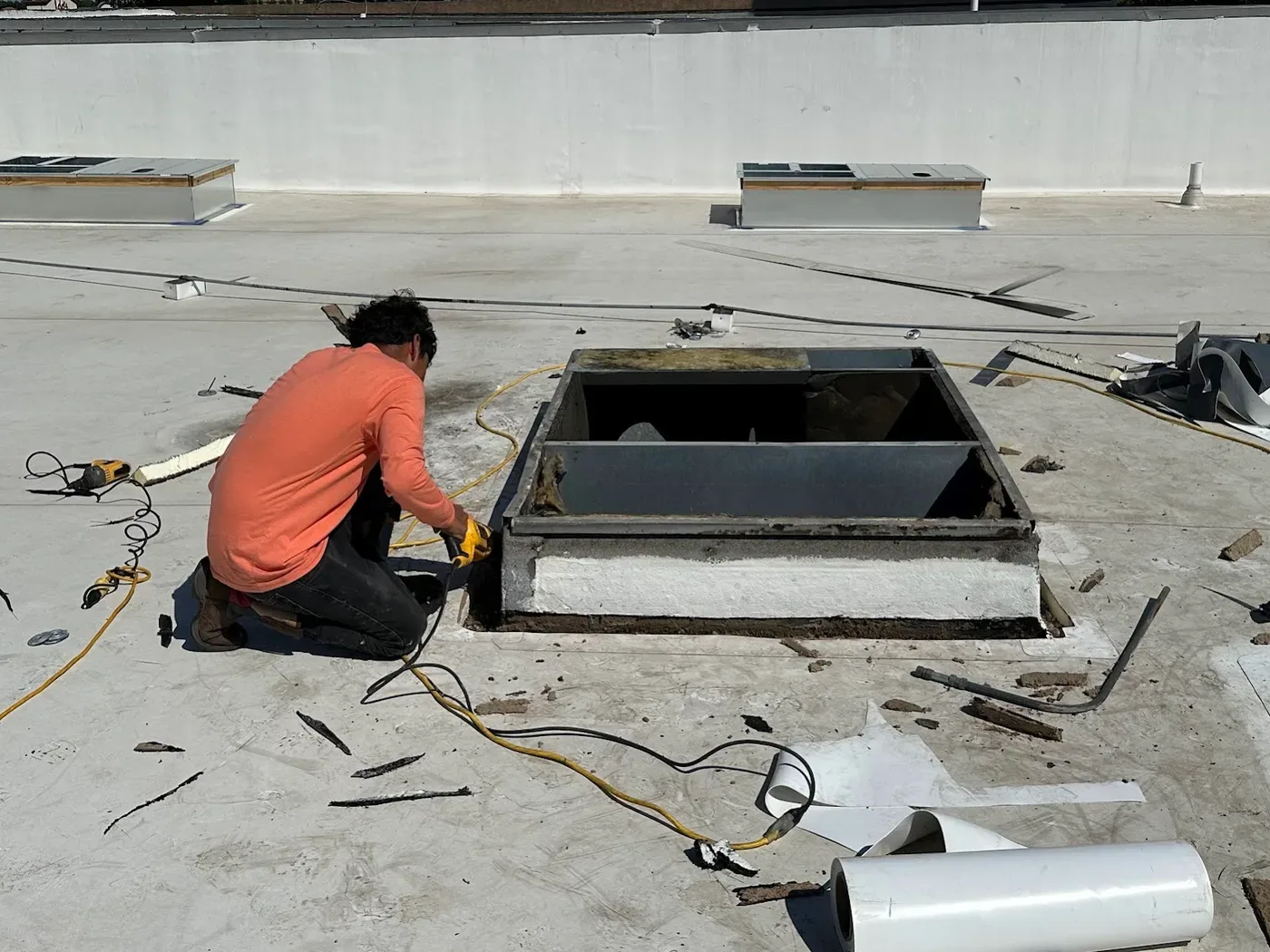
The repair follows the system. On TPO and PVC, we clean the seam, remove loose material and hot-air weld a cover strip or patch over the failed area, then probe it again. On EPDM, we use splice tape or a seam cover strip, with the surfaces cleaned and primed. On modified bitumen, we use heat or cold adhesive to re-seal laps and add a patch where needed. Built-up roofs get flashing cement or a new ply patched in.
The goal is a repair that outlasts the next season, not a smear of sealant. We choose materials that match the existing membrane and follow the maker's instructions for temperature and cure. Our TPO roofing repairs rely on clean surfaces and a good weld; a weld done on a damp or dirty surface fails again. We probe every repair when it is done and record it.
Punctures and tears near seams call for the same care. A tool dropped on a seam or a screw left by another trade can cut through, and a small cut grows with each thermal cycle. We patch with the right membrane and check the surrounding seam, then look at the pattern of membrane puncture repair work to see whether traffic is wearing a path that needs a walk pad.
Widespread failure: when seams say the roof is done
A few open seams can be repaired. A roof with seams failing across large areas is telling a different story. The membrane may have shrunk, the adhesive may have aged out or the original welds may have been poor. Repairing every seam on such a roof is costly and the roof may not last long afterward.
We lay out the choice with numbers on cost drivers: repair the worst seams and monitor, or restore or replace the system. Where the base is sound, a roof coating restoration can seal seams across the field. Where insulation is wet or the membrane is brittle, replacement is the better value. A roof recover falls between the two, and we test whether the insulation under the old membrane is dry enough to allow it.
Long roofs and many seams: planning the walk
Industrial and warehouse roofs have miles of seam. The Fayetteville Industrial Park lies east of Fifteenth Street, and industrial buildings in a park like that can carry long seam lines and many penetrations. We plan the walk by seam run, check every lap and flag the worst first. For owners in Rogers or Springdale with several roofs, we route one crew through all of them on the same trip.
After a hard rain or a freeze, we recommend a quick recheck of seams that were repaired. A repaired seam that holds through one wet month is likely to keep holding. The record of each repair, with date, location and method, goes into the roof file, and it helps decide whether a pattern of failures points to something deeper.
Timing matters for the repair itself. Hot-air welding works best on a dry surface at moderate temperature, so we schedule seam work for mornings in summer and for dry, mild days in cooler months. Cold weather slows adhesive cure, and a rain shower during a repair ruins the bond. We watch the forecast, keep covers on site and return to redo anything the weather interrupted.
Questions About Seam Failure Repair
Commercial Roofing Questions
How can I tell if a leak is from a seam?
Water that tracks along a line on the ceiling often follows a seam above it. We confirm by probing the seams upslope and checking for lifted or soft spots. A water test on a small area can isolate the entry.
Is a seam repair permanent?
A properly cleaned and welded or taped repair should last, but it does not fix the cause if the cause is ponding or movement. We address both so the repair is not tested again right away.
Can sealant fix an open seam?
Only for a short time. Sealant over a moving seam cracks. A weld, tape or cover strip that bonds to the membrane is the lasting repair.
What if the seams fail again after repair?
Then we look deeper: the substrate, the heat load, the drainage or an aged membrane. A repeat failure points to a cause we missed or a roof near the end of its service.
Do you test seams on a new roof?
We probe every seam on a new install before sign-off and record the result. Early correction costs little and sets a clean baseline for later inspections.
Related Commercial Roofing Pages
Read how we handle this work in Fayetteville, AR
Read how we handle this work in Fayetteville, AR
Read how we handle this work in Fayetteville, AR
Read how we handle this work in Fayetteville, AR
Read how we handle this work in Fayetteville, AR
Read how we handle this work in Fayetteville, AR
Read how we handle this work in Fayetteville, AR
Read how we handle this work in Fayetteville, AR