
Membrane Puncture Repair in Fayetteville, AR
Patch punctures, cuts and foot-traffic damage on commercial roof membranes in Fayetteville, AR, with moisture checks, walk pads and a record of every repair.
A puncture is the easiest roof damage to cause and the easiest to miss. A technician drops a nut driver beside a rooftop unit. A tenant's contractor drags a ladder across the membrane. A screw left after a repair gets stepped on. Nobody sees the hole, and weeks later a stain shows on a ceiling tile. By then the insulation under the cut is wet, and a two-minute patch has become a section repair.
Punctures reward early attention. The membrane itself is rarely the expensive part. The wet insulation and the finishes below are. So we treat every cut, gouge and scuff as a roof leak in waiting, and we look for them before the stain appears.
Where punctures hide: equipment, hatches and the walk path
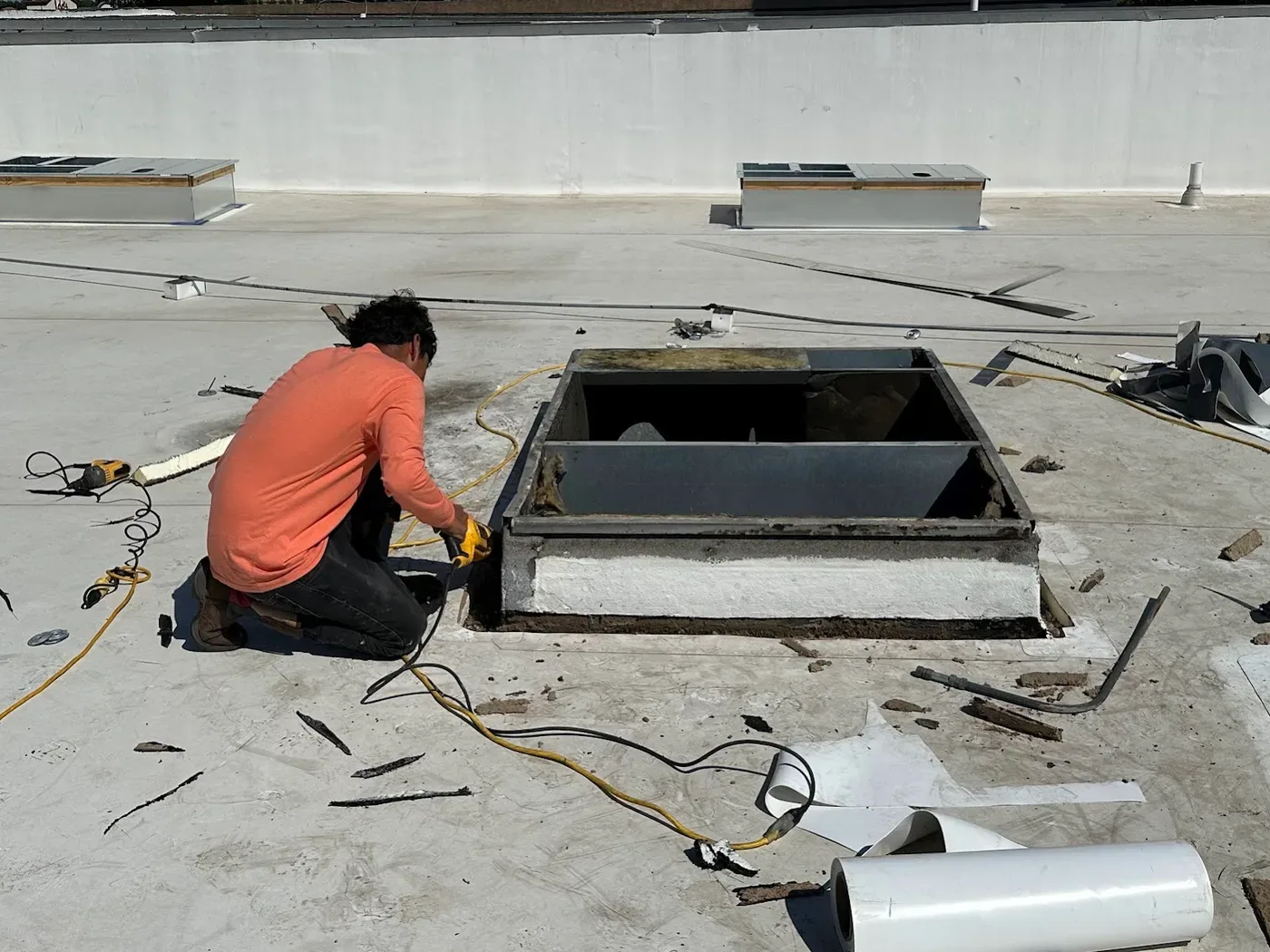
Damage clusters along the paths people take. The route from the roof hatch to the rooftop unit is the first place we look, followed by the area around each unit's access panel, the spot where a ladder rests and any place a trade has worked. Cuts also show up where debris has lain on the membrane, since a branch or a piece of metal that blows onto a roof can sit and wear a hole through a season of wind.
We walk those paths slowly and read the surface for scuffs, gouges, cuts, burn marks and embedded screws. A clean membrane shows a plain worn track where feet have gone. A punctured one shows a ragged mark, a dark stain or a lifted edge. Anything that looks suspicious gets a probe, and anything near a seam gets a closer look, because a cut that crosses a lap is a seam failure as well. We mark each find on a roof sketch with a number and a photo.
Roofs with a gravel surface, a coating or a granulated cap sheet hide cuts better than a smooth single-ply does. On those we use a light angle, a broom to clear loose material and a hand over the surface to feel for soft or lifted spots. Birds and animals sometimes peck or tear at a membrane near a vent, so we also look around vents and ducts for bite marks or nests that may have damaged the surface.
Hidden water: how far a small hole reaches
A small cut can wet a large area. Water enters, spreads along the top of the insulation or inside a board's seams, and may travel a long way before it drips. The ceiling stain is rarely under the hole. To find the real extent, we use a moisture scan or a core sample, then mark the wet boundary on the roof.
If insulation is wet, the repair is bigger than a patch. We cut out the wet material, install dry insulation, patch the membrane over it and weld or adhere the new area into the old. A quick patch over wet insulation traps water and fails. A commercial roof leak repair that begins with a scan costs a little more up front and avoids a return trip.
The patch: size, shape and matching the membrane
A good patch is clean, round-cornered and large enough to cover the damage with room to spare. On thermoplastic membranes, we clean the area, cut a patch with rounded corners and weld it down with hot air, then probe the edge. On EPDM, we prime, apply tape or an adhesive patch and roll it. On modified bitumen, we heat or adhere a patch and seal the edge. On built-up and coated roofs, we use compatible mastic and fabric.
Square corners lift, and a patch made of the wrong material will not bond. We check what the existing roof is made of before choosing, and we follow the maker's instructions for the temperature and the cure. A test weld or a small trial patch tells us whether an older membrane will still accept a new bond. The EPDM roofing and thermoplastic systems each have their own patch methods, and mixing them is the mistake that turns a small repair into a repeat call.
For larger damage, a cut longer than a few inches or a torn area near a corner, a patch is not enough. We cut out the damaged section, replace the underlying layers if wet and install a new piece of membrane that overlaps the old with a proper weld or lap. The new piece is sized to run beyond the damage in every direction. We probe the edges after cooling and record the repair on the sketch with the date and the footage.
Prevention: walk pads, rules and a note to the trades
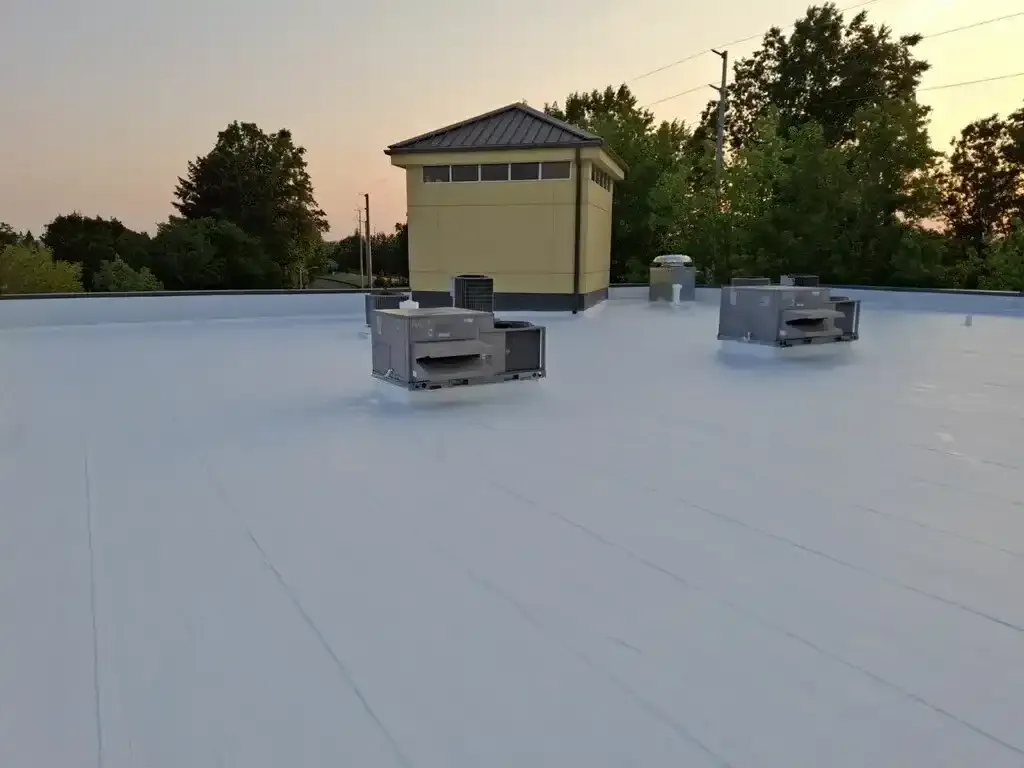
The cheapest puncture repair is the one that never happens. Walk pads on the routes technicians use protect the membrane from wear and dropped tools. A short rule posted at the hatch, such as no sharp tools, no dragging and call before cutting, helps, and so does a clean path of boards when heavy equipment has to cross the roof for a one-time lift. A note to the mechanical contractors about the roof's condition and the warranty, and a request to call us before any penetration, keeps the roof whole.
Poultry processors in Springdale and industrial buildings in the Fayetteville Industrial Park, east of Fifteenth Street, are the kind of property where technicians visit rooftop equipment on a schedule. Wherever a building has rooftop equipment that technicians must reach, the path to it is the part of the roof that wears first. For buildings in Springdale or the park, we map the service routes on the sketch and suggest pads where the wear is heaviest.
Storm debris and hail: holes with an outside cause
Wind throws things. The Springdale tornado of March 30, 2022 tore a wall and part of the roof from a city shop at the airport, a reminder of how much debris a high wind can create. Even a lesser storm can drop a branch, a sign or a loose piece of metal onto a membrane. We photograph the object where it came to rest, measure the damage it left and trace its path across the roof.
Hail can punch through a weak membrane or crush the insulation under it. Stones up to 3.00 inches landed east of Fayetteville in May 2020. After a storm, a walk finds punctures and bruises, and the dated photos support the claim. Our hail damage roof repair work starts with the same careful survey. Owners in Fayetteville and Lowell can call for a post-storm check.

Questions About Membrane Puncture Repair
Commercial Roofing Questions
Can a small puncture be patched without a tear-off?
Yes, if the insulation below is dry. We clean and patch the area, probe the edges and record it. If the insulation is wet, we cut out the wet material first.
How do you find punctures I cannot see?
By reading the walk paths, probing suspect spots and scanning for moisture. A stain on a ceiling is a sign, and we trace upslope from it.
Will walk pads really help?
Yes. They spread loads and protect the membrane where feet and tools land. They are a low-cost addition on any route that gets regular service traffic.
Who pays when a trade damages the roof?
That depends on the contract. We document the damage with photos, the date and the location so the owner and the contractor can settle it with facts.
Does a puncture void the warranty?
It can if repairs are done outside the maker's terms. We read the warranty first and follow its repair rules, and we keep a dated record of the work and the product used.
Related Commercial Roofing Pages
Read how we handle this work in Fayetteville, AR
Read how we handle this work in Fayetteville, AR
Read how we handle this work in Fayetteville, AR
Read how we handle this work in Fayetteville, AR
Read how we handle this work in Fayetteville, AR
Read how we handle this work in Fayetteville, AR
Read how we handle this work in Fayetteville, AR