Storm Damage Roof Repair in Fayetteville, AR
Storm damage assessment and repair for commercial roofs in Fayetteville, AR: hail bruising, wind uplift and debris, sorted into repair now and plan for later.
The storm line moves through on a Tuesday night, and by Wednesday morning the property manager has a dozen messages, an adjuster who wants a date and a roof nobody has seen yet. The first decision is what can wait for daylight and what cannot. Standing water, an open edge and a torn membrane cannot. A hail bruise that is not leaking yet can, but only for a short time.
Spring storms in Northwest Arkansas bring hail, straight-line wind and now and then a tornado, and each leaves a different pattern on a roof. We walk the whole surface, mark what we find on a plan, and sort the damage into repair now, repair soon and plan for later, with a price on each.
Triage: the first walk after a storm
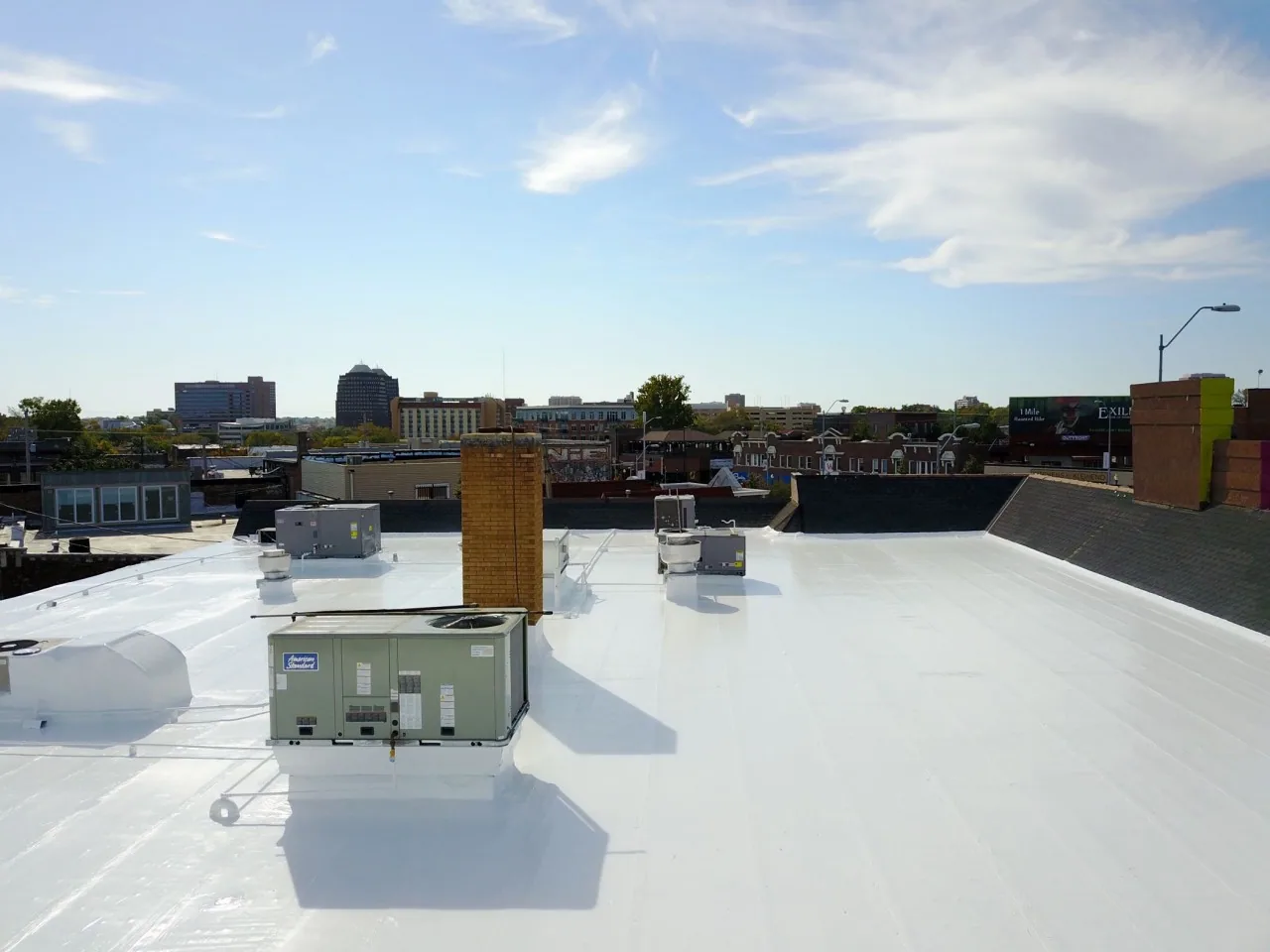
Safety comes first. We look at the roof edge, the access points and any structure that moved before we put a person on the surface. Then we stop the water: loose membrane tacked down, open seams covered, displaced flashing secured and drains cleared. That temporary work is photographed and described as temporary, so nobody mistakes a dry-in for a repair.
The second pass is the survey. We walk in a grid, flag every impact mark, puncture, lifted lap and shifted piece of metal, and note debris that landed on the roof. Roof plan markups and photographs are saved for the adjuster. A same-day dry-in is available when water is entering, and the survey follows as soon as the roof is safe to walk.
Hail: bruises that do not leak yet
The May 2020 hail report that put 3.00-inch stones a mile east-northeast of town also listed 2.50-inch and 1.75-inch hits nearby. A stone that size can crush insulation under a membrane, crack a coating, dent metal edging and open a seam without leaving a hole. The roof may stay dry through the next light rain and fail in the next heavy one.
We look for round marks, soft spots under the thumb and granule loss on cap sheets, and we use a moisture scan where the surface allows. Findings are sorted by how soon they will leak. Damage that is open gets a hail damage repair now. Bruises that are sealed but weakened go on the soon list with a date to recheck. A written record of both protects the owner if a later leak is questioned.
Wind: what a tornado-class event does to a roof
An EF3 tornado crossed Springdale on March 30, 2022, on a 5.2-mile path up to 350 yards wide with an estimated peak wind of 145 mph. It destroyed a large metal building near Highway 412 and a hangar at Springdale Municipal Airport, and it tore a wall and part of the roof from the airport's city maintenance shop. That is a Springdale event, and most storms are far smaller, but it shows how wind goes after edges, panels and anything that holds a pressure difference.
For wind of any size the pattern is the same. The perimeter lifts first, then field seams, then whole sections. We check edge metal, copings, rooftop equipment and anything light, and we look for debris impact. A tornado damage repair is a different scale of job, with structural questions that come before roofing, and we say so when we see it.
Timing: what waiting costs
Waiting one more storm line usually costs more than the repair would have, because wet insulation adds a layer to the bill. A seam opened by wind and left through two rains soaks the board under it, and the repair grows from a patch to a cut-out. We state that in the scope, with the cost of the repair now and the likely cost if the item waits a season.
That comparison drives the sorting. Open items get done at once. Items that are sealed but weakened are scheduled in the next dry window, and items that are cosmetic go on the plan with photographs. The owner decides, with a number beside each choice. A manager answering to an owner or a board can then show why money was spent on three items and deferred on four, with the photographs and readings behind each choice.
Records: what the adjuster will ask for
An adjuster wants a date of loss, photographs of the damage, a description of the cause and an estimate to repair. We provide a dated survey, marked roof plan, close and wide photographs and a priced scope that separates storm damage from age and wear. That separation matters: an insurer pays for the storm, not for the last ten years of upkeep.
Our insurance claim documentation lays the record out in the order a reviewer reads it. Claim amounts and coverage are between the owner and the insurer. What the roof record can do is make sure the roof's condition is on paper before the repair changes it, and that the estimate reflects what the work actually requires.
Questions About Storm Damage Roof Repair
Local: roofs that take the brunt
Tyson, Cargill and George's form the core of Springdale's industrial base alongside several trucking companies, and Rogers has Pinnacle Hills Promenade, a single-level center of about 934,000 square feet that opened in 2006. A single-level center like Pinnacle Hills and a processing complex in Springdale each need a survey drawn from their own roof plans, section by section, before anyone guesses at how much of either roof the storm touched. Owners with roofs in Springdale, Rogers and Fayetteville can have a post-storm survey done across all of them in the same week.
After a regional storm we triage by risk: open roofs first, then roofs with known weak details, then the rest. The quote window stays short, and the manager gets a list ranked by what will leak soonest.
Debris is its own line item. Branches, loose sheet goods and fragments from neighboring buildings land on roofs in a wind event, and they can puncture a membrane when they are dragged or walked on. We remove debris by hand, inspect the surface beneath each piece and photograph the spot before and after, with a tape measure in the frame. A scrape under a branch is easy to miss and expensive to find after three rains, so the survey treats every cleared patch as a possible puncture until the membrane there has been checked.
Commercial Roofing Questions
How soon after a storm should the roof be checked?
Within days, and the same day if water is entering. Hail damage often does not leak until the next hard rain, so a quick survey costs little against a wet-insulation repair.
Can you tell storm damage from old wear?
Yes, and we write it down. Fresh impact marks, clean tears and displaced metal look different from weathering, and the report separates the two so the claim covers only the storm.
Should we repair before the adjuster visits?
Stop the water and keep what was removed, but leave the permanent repair until the adjuster has seen the damage or approved photographs. Our temporary dry-in is photographed for exactly this reason.
What if the roof has hail bruises but no leaks?
Bruises weaken a membrane and insulation, so they go on a soon list with a date to recheck. Open damage gets repaired now, and sealed damage is monitored.
Do you handle tornado damage?
We handle roof work on buildings that are safe to enter. Where the structure moved, an engineer's review comes first, and we coordinate the roofing after.
Related Commercial Roofing Pages
Read how we handle this work in Fayetteville, AR
Read how we handle this work in Fayetteville, AR
Read how we handle this work in Fayetteville, AR
Read how we handle this work in Fayetteville, AR
Read how we handle this work in Fayetteville, AR
Read how we handle this work in Fayetteville, AR
Read how we handle this work in Fayetteville, AR