Roof Drains, Scuppers and Ponding Correction in Fayetteville, AR
Drain, scupper and ponding correction on commercial roofs in Fayetteville, AR, from clearing a clogged bowl to adding a cricket or tapered section.
Leaves pile into a drain bowl in October, a wet November packs them down, and by the first freeze there is a pond on the roof that nobody noticed until the ceiling tile dropped. A clogged drain is the cheapest repair in roofing and the most expensive thing to ignore. The tenant call comes at the end of a long rain, and the manager is left to decide between a quick clearing and a deeper look at why the water stayed.
Drake Field averages about 46.96 inches of precipitation over roughly 113 days of measurable rain, with 5.89 inches in May alone, so a roof that drains slowly in Fayetteville, AR is carrying weight and moisture for much of the year. Every extra day that water stays is a day the seams, the membrane and the insulation below carry a load they were never sized to hold.
Clearing: the first fix and what it tells us
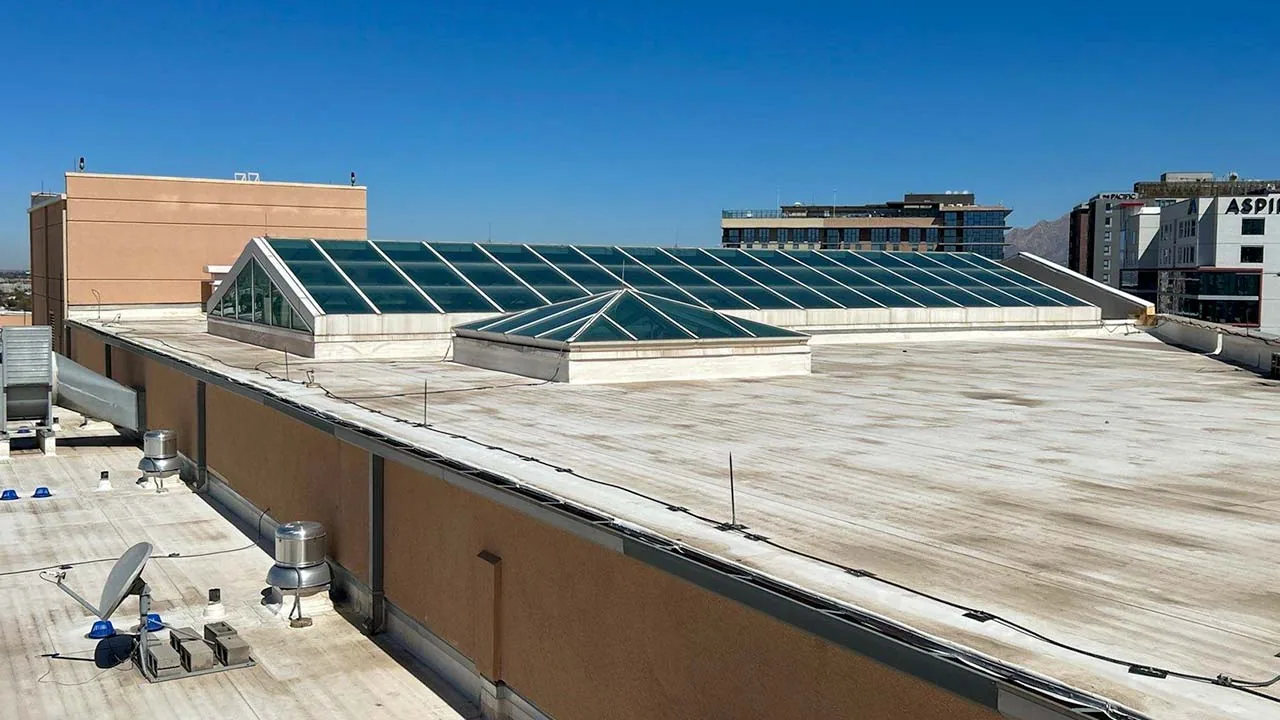
We start by clearing and flushing every drain, scupper and downspout we can reach, and we watch how fast water leaves. A bowl that clears at once was just full. A bowl that still holds water after clearing points to a blocked line, a low spot around the drain or a roof that does not fall toward the outlet. Each of those has a different fix and a different price.
Photographs before and after show the owner what was in the drain and how much came out. We also check the strainer, the clamping ring and the seal between the membrane and the drain body, since a loose ring lets water run down the outside of the pipe and shows up as a stain far from the outlet. Small repairs are done on the spot, and larger ones go on the work order, where a leak that traces to a failed outlet can be handled as a leak repair with the drain work priced in the same visit.
Clearing also gives us a look at the membrane around each bowl. Drain bowls are where a roof sees the most standing water and the most foot traffic from maintenance crews, and the sheet around them wears first. We press the flashing, check for hairline cracks and note any ring of staining that points to a slow leak at the clamp.
Ponding: when water stays after the rain
Water that remains on a roof more than a day after rain is a problem. It adds weight, speeds membrane aging, grows algae and opens seams over time. In Fayetteville the freeze-and-thaw week turns a pond into ice, which can lift an edge or crack a sealant joint. Measuring how deep and how long the water stays tells us whether the cause is a clogged outlet, a sagging deck, a bowl set too high or a roof built without enough fall.
The answer decides the fix. An outlet issue is cheap. A deflected deck may need ponding water repair with a tapered insulation section or an added drain. A bowl set high can be lowered or replaced. We price each option and say which will keep water off the roof and which only moves it a few feet.
Crickets and tapered sections: building fall into a flat roof
A cricket is a small sloped build-up behind a curb, wall or unit that sends water around the obstacle toward a drain. Many roofs have a dry-looking field with a stained strip behind each rooftop unit, because water stands in the pocket there. Adding crickets is one of the least expensive ways to move water, and we install them with sloped insulation and a membrane tied into the existing roof.
For larger problems, a tapered insulation system builds slope across a whole section. It is also a natural part of a reroof, as the insulation and cover board package can be designed so every drain sits at the low point. The price depends on thickness and area, and we show the cost per section so the owner can drain the worst ones now and the rest later.
Scuppers and overflow: the second line of defense
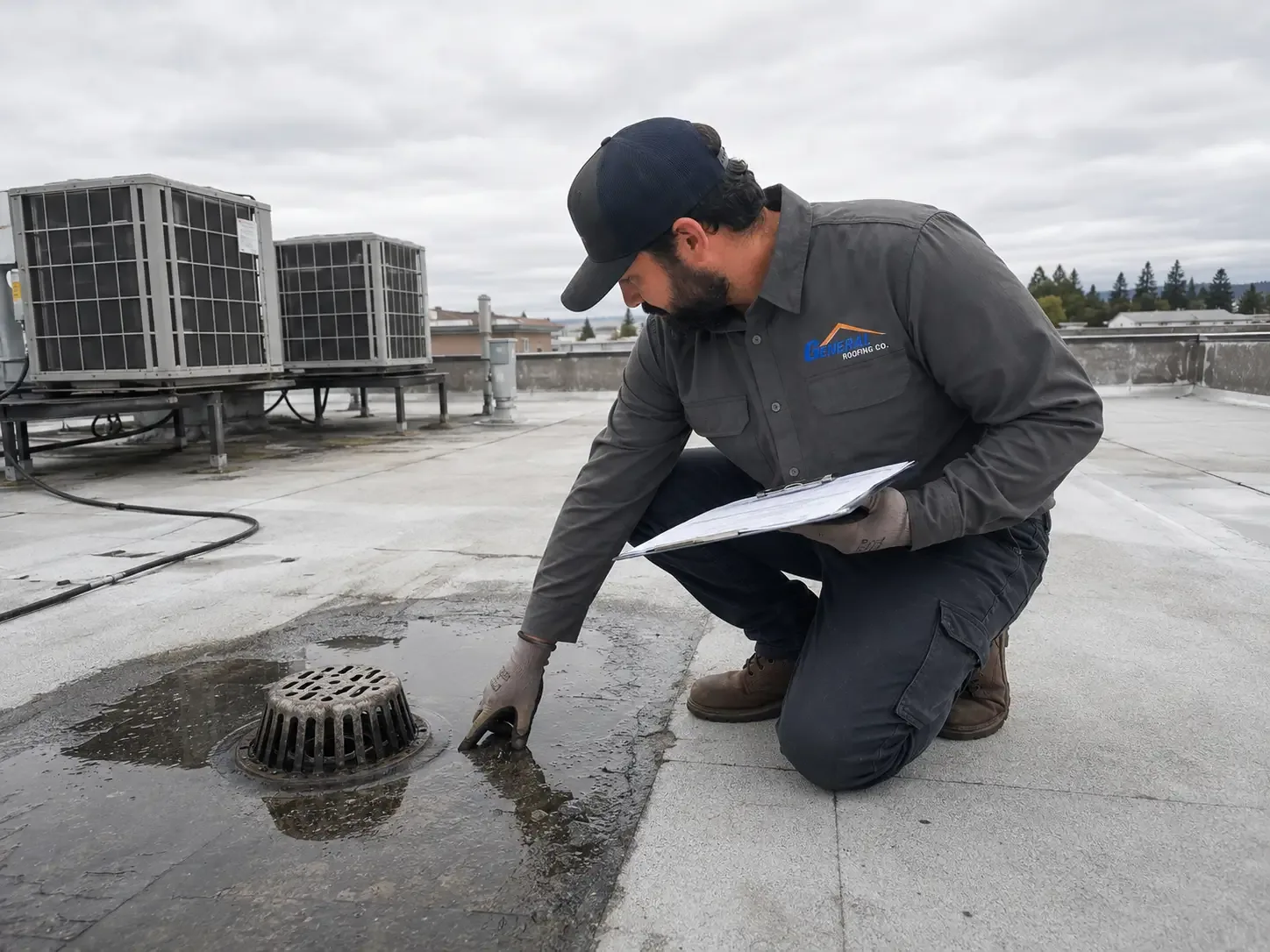
Many flat roofs with parapets rely on scuppers, which are openings through the wall, and on overflow scuppers set a little above the main ones. If a main drain clogs, the overflow lets water out before the roof carries too much weight. Overflows are frequently missing, blocked by a membrane flashing or set too high to work, and a roof without a working overflow is one clog away from a structural problem.
We check the size and height of every scupper, the condition of the flashing around it and whether the downspout below can take the flow. Where a scupper has failed, the repair includes the flashing and the metal collector. A heavy spring storm line is when this matters, and the cost of adding an overflow is small against the cost of a collapsed ceiling.
Cold: freeze-and-thaw and the drain line
Cold snaps matter too: the record low at Drake Field was minus 20 F on February 16, 2021, and freezing days recur through every winter, which turns a trapped pond into ice. Water left in a drain line freezes, can split a pipe, and blocks the next melt. Leaders running through unheated space are the most exposed.
We look at where the lines run, whether they are insulated and whether the outlets are protected from ice. Where melt has nowhere to go, it refreezes on the roof edge and finds the nearest open joint, which is how many snow and ice damage calls begin. A fall visit that clears the drains and checks the lines is the cheapest way to avoid a January repair.
Questions About Roof Drains, Scuppers and Ponding Correction
Local: roofs where drainage decides the budget
Northwest Arkansas Mall in Uptown Fayetteville opened in 1972 and holds about 820,000 square feet of leasable single-level retail. On a wide single-level building the water has a long run to the nearest outlet, and one clogged drain leaves little margin before a pond forms.
For owners in Uptown Fayetteville, the industrial park and Farmington, we map every drain, scupper and downspout on the roof plan, record the condition of each and set a cleaning schedule. A map like that makes the next tenant call a five-minute question, and the cleaning log shows whether debris is building up faster than the schedule expects.
Commercial Roofing Questions
How often should roof drains be cleared?
Twice a year at minimum, after leaf fall and before spring storms. Roofs under trees need more, and we set the interval from the first year's debris.
Is a little ponding normal?
Water that is gone within about a day is usually acceptable. Water that stays longer is a problem we measure, and the fix depends on whether the cause is a clogged drain or a roof that lacks fall.
Can a drain be added to an existing roof?
Often yes, with a core cut through the deck, a sump and a leader. The structure and the interior space below have to allow for the pipe, and we price the plumbing coordination separately.
What is an overflow scupper?
A scupper set slightly above the main drain so water leaves the roof if the drain clogs. It protects the roof from carrying too much weight and should be checked each visit.
Will tapered insulation fix ponding?
If the deck can carry it and the drains sit at the low points, yes. We design the taper so water flows to an outlet, and we price it by section.
Related Commercial Roofing Pages
Read how we handle this work in Fayetteville, AR
Read how we handle this work in Fayetteville, AR
Read how we handle this work in Fayetteville, AR
Read how we handle this work in Fayetteville, AR
Read how we handle this work in Fayetteville, AR
Read how we handle this work in Fayetteville, AR
Read how we handle this work in Fayetteville, AR