
Roof Insulation, Tapered Systems and Cover Board in Fayetteville, AR
Roof insulation, tapered systems and cover board for commercial roofs in Fayetteville, AR: hail resistance, drainage, energy code and cost in a reroof.
Most of what a roof costs sits in the part nobody sees. The membrane gets the attention, but the insulation under it holds the heat, sets the slope and takes the hail, and in a reroof it is often the biggest line on the quote after labor. A property manager comparing bids needs to know what each one assumes about the insulation, because two roofs priced alike on top can be very different underneath.
We write the insulation scope as its own decision: what is there now, what it should be replaced with, how thick it needs to be and whether a cover board belongs between it and the membrane. The answer affects energy cost, drainage, hail resistance and how long the roof lasts.
Existing: what is under the membrane now
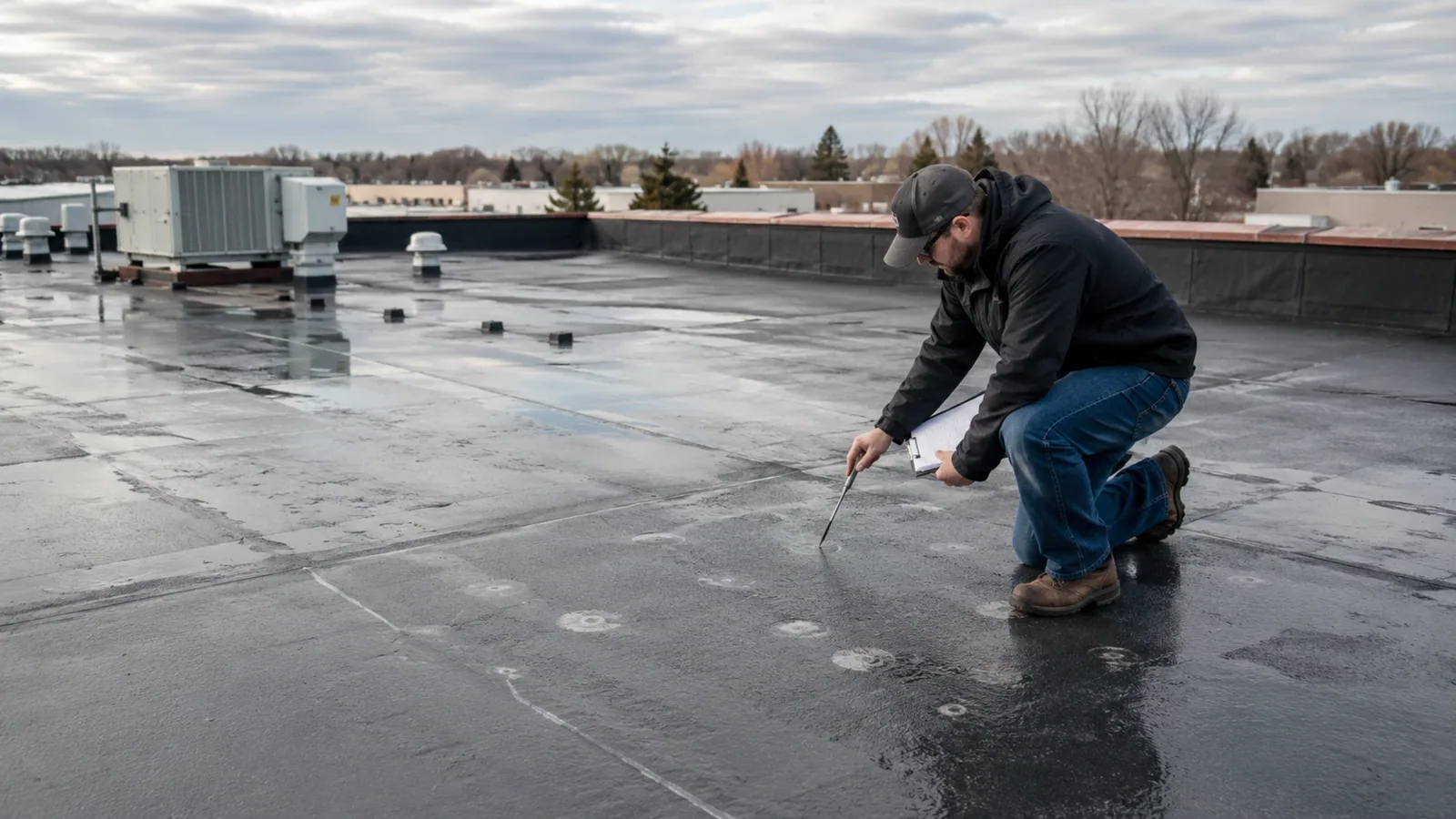
Before any new insulation is specified, we find out what is in place: type, thickness, attachment and moisture. A scan shows where it is wet, and cores show what kind it is. Polyisocyanurate, expanded polystyrene, extruded polystyrene, perlite and wood fiber all appear on older roofs, and each reacts differently to water, heat and the glue or membrane laid over it.
Wet insulation is the line item that moves a quote the most. It loses its R-value, adds weight and holds water against the deck. Dry sections can often stay, which saves money, but only if the scan and cores prove it. Our infrared moisture survey gives the map, and the quote then shows the cost of removing and replacing only the wet area, with a unit price in case the area is larger than the scan suggests.
Attachment is the other question. Insulation held down with fasteners, adhesive or ballast behaves differently in wind, and an old roof with loose boards needs more than a new membrane to pass a wind uplift review. We check how the boards are held, probe for movement underfoot and note any area where the board has crushed, since a soft spot under a membrane is where a foot or a hailstone does its damage.
Code: what the energy rules ask for here
The 2021 International Building Code reached Arkansas through the 2021 Fire Prevention Code on January 1, 2023, and the commercial energy code stands at ASHRAE 90.1-2007 (2009 IECC) from January 1, 2015. Those are the baseline references, and a local permit office may apply its own reading.
When a roof is replaced, the permit review looks at insulation levels, and the thickness we recommend may exceed the minimum if the owner wants lower operating cost. We state the code reference the quote relies on, the thickness it produces and the thickness we suggest, and we note where the permit office has the final word. The manager can see what is required, what is optional and what each option adds to the price, with the source of each requirement named, and a replacement scope built that way is easy to defend to an owner.
Tapered systems: making water move
A tapered insulation system uses boards cut at different thicknesses to build slope into a flat deck. Water then flows to drains instead of waiting for them, and crickets send it around curbs and walls. A roof that ponded for years can be fixed without touching the structure, because the slope is built on top.
Design matters. The layout has to put every drain at a low point and every cricket where water would otherwise stand. We prepare a taper plan with board thicknesses and positions, and review it against the drain locations before ordering. Taper adds cost, which we show as a separate line with a drawing of the board layout, and it is often cheaper than repeated ponding water repair on a roof that holds a pond after every storm.
Cover board: protection that earns its cost
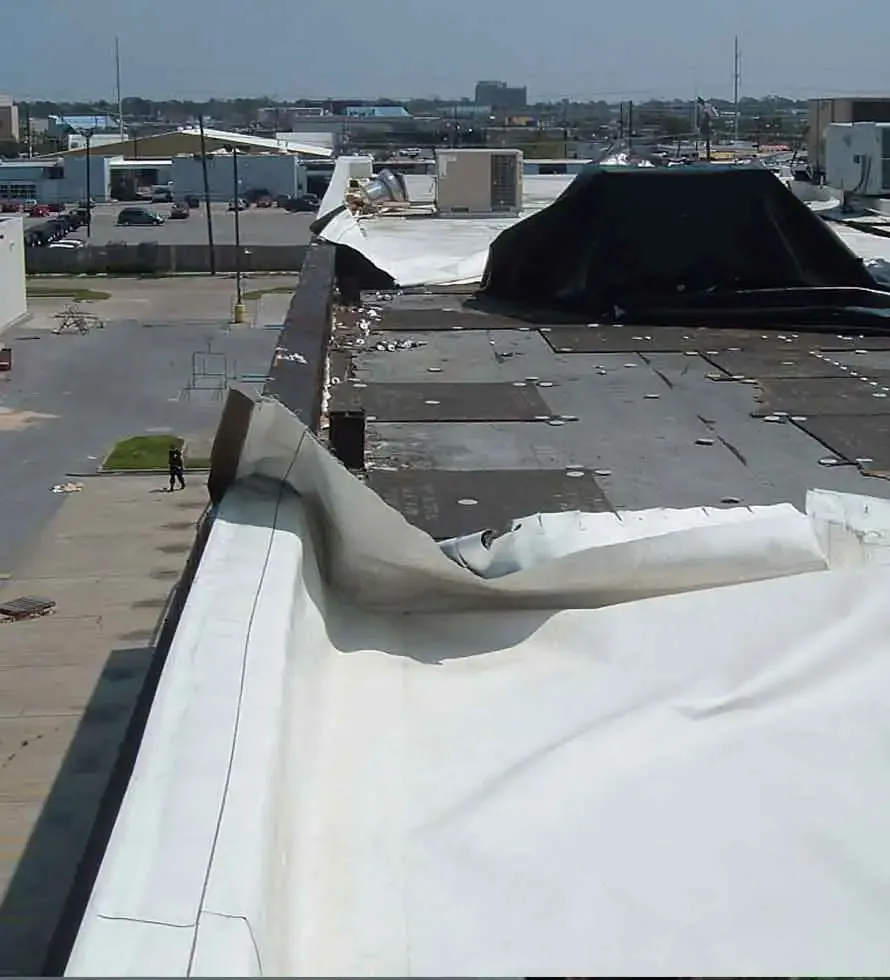
A cover board is a rigid panel installed between the insulation and the membrane. It protects soft insulation from foot traffic, resists hail and wind-driven impact, gives a better surface for adhesive and helps with fire ratings in some assemblies. With May 2020 stones of 3.00 inches reported east-northeast of Fayetteville, a cover board is one of the cheaper ways to protect the layer underneath.
It also helps a recover. Over an old roof, a cover board separates the new membrane from old asphalt or wet pockets and spreads loads. Different boards suit different membranes, and some manufacturers require a particular type for a warranty. We specify the board that matches the membrane and the exposure and show the added cost separately, so the owner can decide with the numbers visible. Boards come in several types, such as gypsum-based, high-density polyiso and wood fiber, and the quote names the one chosen and the reason.
Cold and heat: why thickness is not the only number
The range an assembly lives through runs from record highs near 111 F to a reading of minus 20 F on February 16, 2021, which tied for the 8th-coldest in Arkansas history. A roof assembly swings across that range, and insulation affects how much of the swing reaches the membrane. Thicker insulation holds more heat in winter and lets less in during summer, though it also means the membrane runs closer to outside temperature and sees larger swings.
Freezing highs show up on roughly 10 days a year. We check that the assembly can shed moisture, whether through vents, a vapor retarder or a membrane that can dry, and we do not simply add thickness to a roof that cannot breathe. Sloped insulation near walls and curbs also needs transitions, and we detail them.
Questions About Roof Insulation, Tapered Systems and Cover Board
Local: new roofs and old ones
The 350-acre Walmart campus in Bentonville began opening in January 2025, replacing a home office of more than 20 buildings along Walton Boulevard. A campus that new would have been specified to the code in force, while buildings from earlier decades carry whatever was installed then. Either way, the condition of a given roof only shows up on the roof itself.
For owners in Bentonville, the Walton Boulevard corridor and Fayetteville, the first step is a survey of what is on the roof. The quote that follows lists each insulation choice, in order of how the layers sit on the roof, with its cost and its effect on energy, drainage and warranty, so the manager can make the tradeoff with the evidence on the table and carry the decision to the owner with numbers behind it.
Commercial Roofing Questions
Do I need to replace all the insulation in a reroof?
Not always. Dry insulation in good shape can often stay. A scan and cores show which areas are wet, and only those need to come out.
What is the difference between tapered insulation and a cricket?
Tapered insulation builds slope across a section of the roof. A cricket is a small sloped section that sends water around an obstacle. Many roofs use both.
Is cover board worth the added cost?
On roofs that see hail or foot traffic, usually. It protects softer insulation and gives the membrane a firmer base. We price it as a separate line so you can compare.
What R-value should the new roof have?
At least what the permit office requires, and often more if lower operating cost matters. The quote lists the required and the recommended thickness side by side.
Can insulation be added without a reroof?
Rarely on an existing membrane. Adding thickness usually means lifting the membrane, so it is done during a recover or replacement when the roof is already open.
Related Commercial Roofing Pages
Read how we handle this work in Fayetteville, AR
Read how we handle this work in Fayetteville, AR
Read how we handle this work in Fayetteville, AR
Read how we handle this work in Fayetteville, AR
Read how we handle this work in Fayetteville, AR
Read how we handle this work in Fayetteville, AR
