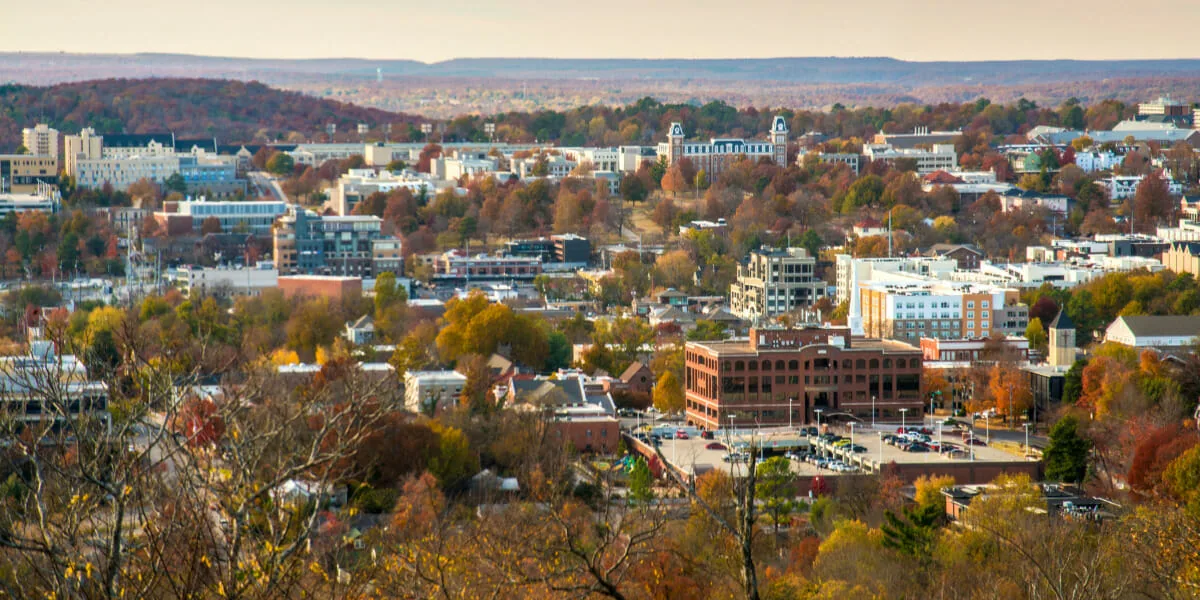
College and University Roofing in Fayetteville, AR
College and university roofing in Fayetteville, AR: campus roof surveys, summer reroof blocks and storm repair planned around semesters and Razorback Saturdays.
A campus facilities office does not have one roof. It has dozens, built across different decades, and each one is on its own clock. A residence hall roof that gets a leak in October lands on the same desk as a lab roof that needs a rooftop unit moved before spring. In Fayetteville, AR the University of Arkansas is among the largest employers in town, and the same pattern holds on any campus in Northwest Arkansas: many roofs, a short summer, and a budget that has to be argued for each year.
Campus survey: ranking every roof on one list
The first step for a campus is a survey that ranks every roof by age, leak history and remaining life. We walk each building, probe seams, check drains and flashings, and record what we find against a roof plan. The result is one list the facilities director can carry to the budget office, with roofs sorted into repair now, recover soon and replace on a schedule.
A ranked list changes the conversation. Instead of reacting to the loudest leak, the campus funds the roofs that are about to fail and leaves the sound ones alone. Our roof condition reports carry photographs and a short narrative for each building, so the data survives staff turnover. A campus that keeps the report current can see which roofs slipped since last year and which repairs held. The survey also catches the small problems that quietly add up, such as a drain strainer missing on a lower roof, a loose coping joint, or a rooftop unit set without a walk pad, each cheap to fix in a dry week and costly after a wet one.
Semester calendar: when roof crews can work
Residence halls empty out in May and fill again in August, and that is the major window for any roof directly above beds. Classroom and lab buildings follow a similar calendar, with extra care around research spaces. Summer session, camps and conferences tighten the window further, so a facilities office that sends a bid package in February gets better crews than one that waits until the semester ends.
We schedule campus work in blocks and give each block a date, a dry-in point and a walk. Noise-sensitive spaces such as recording rooms, labs with instruments and exam halls get a separate notice. Any roof over a lecture hall is worked outside class hours, and finals week is a hard stop. The punch list walk happens with the facilities representative before the crew demobilizes. Residence hall work adds a second layer: the housing office needs the room count affected on each floor, and we keep a daily update going to one contact so students are not left guessing. Lab buildings add another, with vibration, fumes and dust checked against what the lab can tolerate before a rooftop unit is lifted.
Razorback Saturday: roof work around stadium weekends
The Razorback Stadium site seats 76,212 and was expanded in 2001 and again in 2017 and 2018, and a home game puts a crowd on campus streets alongside work trucks. Trucks and cranes do not belong on campus streets on those days, and buildings near the stadium lose their usual delivery access.
We plan material deliveries for weekdays, keep cranes down on game weekends and schedule loud work away from the home Saturday calendar. A roof that must stay open through a hold weekend is dried in, taped and ballasted so a wind gust cannot move it. The same planning applies to graduation weekend and move-in week. These are the days that decide whether a facilities director gets a quiet phone. A recreation center roof near the crowds gets the same rule, and any lift that needs a street closure is booked with the city well ahead of the date.
Storm risk: hail, wind and the repair that cannot wait
May 2020 brought 3.00-inch hail reports about a mile east-northeast of Fayetteville. Stones that size can crack a skylight, bruise a membrane and crush the insulation under it, and a campus has a lot of roof exposed at once. After a storm we sweep priority buildings first: residence halls, labs and any space with sensitive equipment. We tarp or dry in where the water is entering, then return for permanent repair.
Wind also matters on tall or exposed buildings. A March 2022 EF3 tornado struck Springdale with winds estimated at 145 mph and ripped a wall and part of the roof from a city maintenance shop, a reminder of what high wind does to roof edges. Our storm damage roof repair work starts with the perimeter, because that is where uplift begins.
Roof mix: historic roofs, labs and athletic buildings
A campus holds nearly every roof type. Older academic buildings may have steep slopes, slate or clay tile, metal copings and built-in gutters. Newer labs and residence halls usually carry low-slope membranes with heavy rooftop equipment. Athletic buildings bring large spans and long drainage paths. Each type is repaired differently, and a mismatch between repair material and roof type is a common source of repeat leaks.
At a lab, we coordinate with the building engineer before any curb or unit is touched, since a leak into a research space can cost far more than the roof. Research labs borrow controls from a hospital campus, including air-intake planning and shutdown windows. For athletic buildings, we look hard at drains, because a long roof sends a lot of water to few outlets.
Questions About College and University Roofing
Budget: building a multi-year reroof plan
Colleges plan capital over years, and roof money competes with everything else. A good plan gives the board a sequence: which roofs get repairs this year, which get a recover in two years and which need replacement. We price each step and show what each deferral would cost. For a campus in Fayetteville, the same plan can include regional campuses such as NorthWest Arkansas Community College in Bentonville and John Brown University in Siloam Springs when the owner asks for a wider program.
Commercial Roofing Questions
How do we start a campus-wide roof program?
Begin with a survey of every roof, ranked by age and leak history. A one-page summary per building, with photographs and a rough budget line, lets the facilities office compare roofs fairly and request money in order of need.
Can roof work happen while classes are in session?
Small repairs can, on dry days and outside class hours. Larger tear-offs wait for summer. Noise-sensitive rooms get a schedule and a contact name, and any work above a lecture hall or lab waits for a quiet period.
What happens if a storm hits during a summer reroof?
Open sections are dried in first. The crew stops opening new areas when the forecast turns, and temporary covers go on anything exposed. Stored material is strapped down. The schedule slips a day or two, but the campus stays dry.
How do we protect research spaces from roof leaks?
Name the sensitive rooms before work starts. We keep water out with phased dry-in, stage temporary protection at the work area and agree on a person to call if something drips. Equipment under a roof being worked should be covered.
Should a campus replace roofs or coat them?
A coating makes sense on a roof that is dry, attached and in fair shape, and it costs far less than replacement. Wet insulation, a failing membrane or repeated leaks point to replacement. A core cut and moisture survey separate the two.
Related Commercial Roofing Pages
Read how we handle this work in Fayetteville, AR
Read how we handle this work in Fayetteville, AR
Read how we handle this work in Fayetteville, AR
Read how we handle this work in Fayetteville, AR
Read how we handle this work in Fayetteville, AR
Read how we handle this work in Fayetteville, AR