Big-Box Retail Roofing in Fayetteville, AR
Big-box retail roofing in Fayetteville, AR: large low-slope roof surveys, early-morning work and hail repair planned around store hours and the holidays.
A big-box store has one very large roof and one very small tolerance for water. A drip over a sales aisle brings buckets, closed lanes and a regional manager on the phone. The roof also has a lot of surface to inspect, hundreds of penetrations to flash and a long list of units that are serviced from the roof every month. In Fayetteville, AR the question for a facilities manager is rarely whether the roof leaks. It is how many places it could leak, and which ones to fix before the next spring storm line.
Size: why a large roof fails in small places
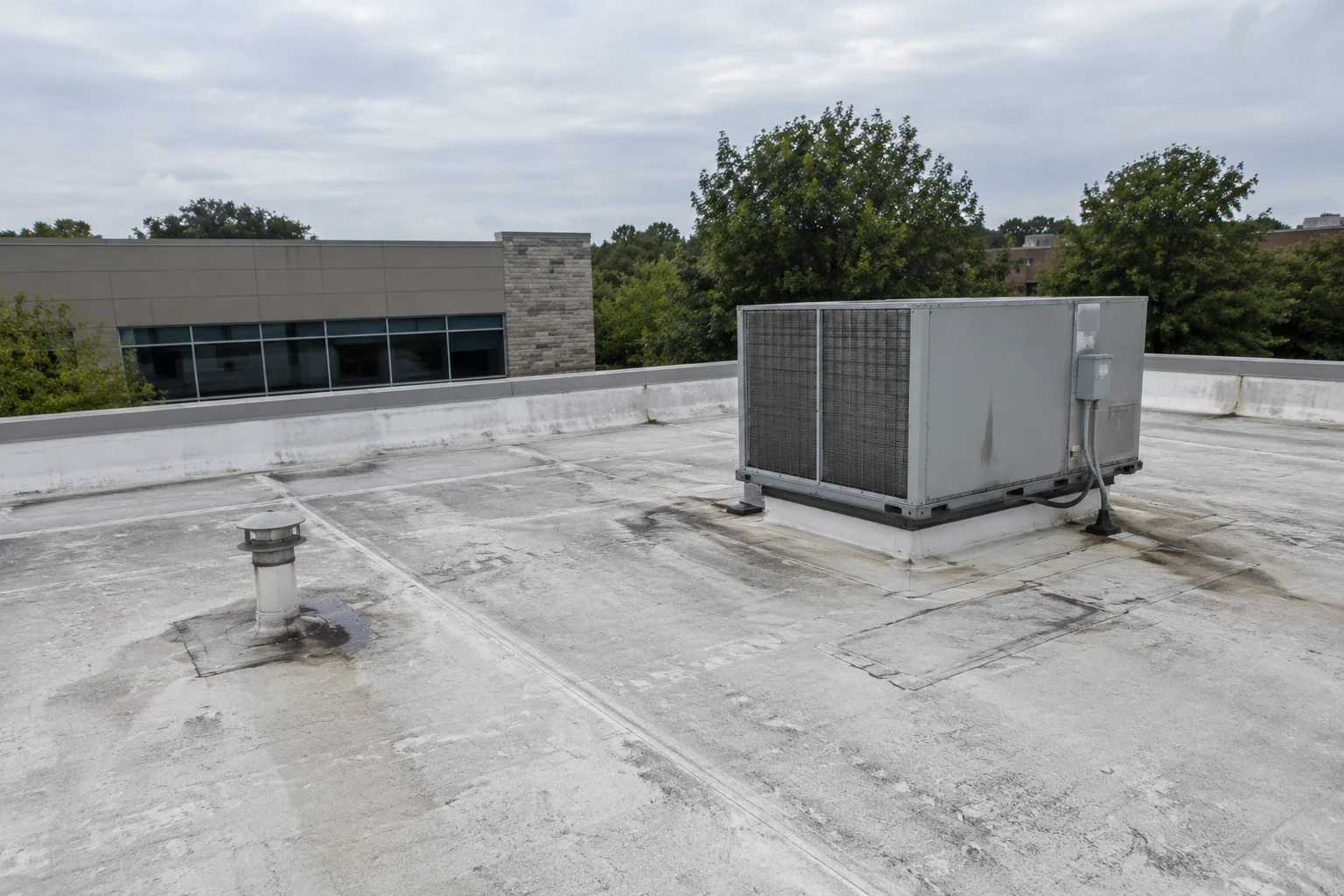
A large roof is a lot of membrane, but the membrane is rarely the problem. Leaks start at the details: a seam that opened where two sheets meet, a flashing that pulled from a wall, a pipe boot that dried out, a drain strainer that clogged. Every one of them is small. A big-box roof has hundreds of them, so the work is a count and a map, not a single repair.
We walk the roof in a grid and log each defect with a photo and a position on the plan. The result is a numbered repair list that a store manager, a regional facilities contact and a landlord can all read. Sorting that list into repair this month and plan for the next capital cycle is where the savings show up. Our planned commercial roof repair follows the list in order. Items near drains and rooftop units go first, because those are the places where water stands or where service technicians walk, and the numbered list lets a regional manager approve a block of repairs with one signature instead of one call per leak.
Store hours: night work, early starts and the holiday freeze
A big-box store cannot close for a roof. Work happens around the doors, the dock and the customers. Where it is safe, the crew starts at dawn and stops before the lot fills. Loud work is moved to the hours before opening. Lifts and hoists are placed away from entrances and fire lanes, and a flagger stands at the delivery route.
The holiday season is a hard stop. Retailers do not want a roofing crew near the building between early November and the new year, and neither do we. Large work is planned for spring and early fall, with repairs on dry days between. A manager who sends the store list in January gets a quote window that leaves room for weather delays, and a roof that is dry when the holiday traffic arrives.
Power centers: roofs beside roofs
The Pinnacle Hills area in Rogers shows how retail clusters. Pinnacle Hills Promenade, with stores such as Bass Pro Shops, Dillard's, JC Penney, Target and Best Buy, sits beside the Pinnacle Hills Crossing power center that holds PetSmart, TJ Maxx and Ulta. Stores like these can each have their own roof, owner or lease terms and schedule, and the lot between them is shared.
When several roofs sit next to each other, the lot becomes the problem. Staging, lifts, dumpsters and trucks compete for space, and one tenant's closed lane can block another's delivery. We map the site, agree on a staging area with the property manager and keep a single contact for every store on the lot. The approach carries over to shopping center roofing where in-line bays share the same drainage.
Hail season: what a large flat roof takes
Hail is the weather that tests a big-box roof most. In May 2020 the National Weather Service logged stones up to 3.00 inches a mile east-northeast of Fayetteville, and 2.50 and 1.75 inch hail in the same area. A flat roof of any size takes the impact across its whole surface, and the damage may be hidden under a surface that looks fine.
After a storm we survey the whole roof, not just the places we can see from the ladder. Bruises, split seams, damaged skylights, bent units and clogged drains all go on the plan. The file we hand back supports the insurance claim, which for a national retailer often runs through a separate risk department. If water has already entered, we dry in first and send photographs the same day.
Roof systems: what fits a large retail roof
Many retail roofs are single-ply membranes over insulation on a metal deck. TPO is a frequent choice for reflective, welded roofs, and a mechanically attached system goes down fast. Older buildings may carry ballasted or built-up systems that have been patched many times. Arkansas lists its commercial energy code as ASHRAE 90.1-2007 (2009 IECC), and the state follows the 2021 International Building Code, so insulation and wind design are checked against those editions when a roof is replaced.
We choose by condition. A dry roof with sound seams may be a candidate for a coating or a recover. A roof with wet insulation needs the wet areas cut out. A moisture survey tells us the difference before a purchase order is written. Where the building holds a supermarket or a pharmacy counter, refrigeration and exhaust equipment add curbs and weight to a grocery store roof, and that equipment list is worth reading before any quote goes out. Curbs, pipe supports and walk pads are priced as separate lines, so the owner can see what the details cost against the field of the roof.
Questions About Big-Box Retail Roofing
Budget: repair lines, reserve lines and the cost of waiting
A tenant that leases its building may share roof costs with the landlord, which means two budgets for one roof. We write the estimate to make the split clear: what is a maintenance repair, what is a capital replacement, and what is storm damage. A roof that gets small repairs every year and an annual inspection tends to cost less over time than one that is left alone until a failure.
For retailers in Rogers, Bentonville and Fayetteville, a rough budget range before the next storm week lets the facilities group decide what goes into this year's work order and what goes into reserve. The preventive maintenance visit is the cheapest line in the budget.
Commercial Roofing Questions
How long does a big-box reroof take?
The schedule follows the roof's area and the weather, and we work it in sections so the store keeps operating. A written phase plan gives a date for each section. Rain days add time, and holiday blackouts shape the start date.
Can the store stay open during the work?
Yes, with planning. Doors, fire lanes and delivery routes are protected, loud work is timed for early hours, and interior protection goes under any area where the deck is open. Store managers get a daily briefing from the foreman.
What if a leak appears in a sales aisle?
Protect the merchandise and call. We send a crew to find the entry point and dry it in, then return for the permanent repair. The photographs and notes from the visit go to the facilities contact and to the landlord.
Does hail require replacing a large retail roof?
Not always. If the damage is isolated and the insulation is dry, targeted repair works. If bruising is widespread and insulation is crushed or wet, replacement or a recover becomes the better value. A documented survey shows which case applies.
How do we compare bids for a large retail roof?
Line them up by scope, not by total. Check the insulation, the attachment pattern, the flashing details and the warranty terms. A bid that skips tear-off of wet areas or omits curb work will look cheaper and cost more later.
Related Commercial Roofing Pages
Read how we handle this work in Fayetteville, AR
Read how we handle this work in Fayetteville, AR
Read how we handle this work in Fayetteville, AR
Read how we handle this work in Fayetteville, AR
Read how we handle this work in Fayetteville, AR
Read how we handle this work in Fayetteville, AR
Read how we handle this work in Fayetteville, AR