Military Installation Roofing near Fayetteville, AR
Roofing on National Guard and military facilities near Fayetteville, AR: access and escorts, UFC roofing criteria, unit schedules and hail and wind planning.
A leak over a unit's storage bay is more than a maintenance ticket. It touches equipment, calendars and sometimes a chain of command that wants a cost and a date before anything starts. A facilities officer comparing roofing quotes for a Guard or military building needs answers on access, standards and timing that an ordinary commercial quote skips.
Arkansas Army National Guard units are based in Fayetteville, Bentonville, Rogers and Siloam Springs, within Fayetteville and about 20 to 35 miles north and west. Fayetteville hosts the 142nd Field Artillery Brigade headquarters and the 142nd Signal Company. At facilities like these the questions are about gates, escorts, specifications and calendars, while the membrane and flashing follow the same rules as any other low-slope roof.
Access: who gets through the gate
Roofers do not simply drive in. Each worker is cleared under the facility's own procedure, which may mean identification checks, a vehicle search, a list of names submitted ahead of time and an assigned escort. The escort's availability sets the working hours: when the escort has to leave, so does the crew.
That shapes the first call. We ask for the clearance process, send names and plate numbers early, list tools and materials for inspection and time arrivals to the escort's day. A missing badge or a late delivery can cost a full shift, so the sequence carries a margin. Every facility has its own way of doing this, and we follow whatever the facilities office hands us.
Safety paperwork runs alongside. A site-specific safety plan, fall protection details, a hot-work permit where flame is used and proof of insurance usually go in with the access request. We prepare them early because they are what hold up a first day on the roof more often than weather does, and they are easy to write once the roof type and the work sequence are known.
Standards: the Unified Facilities Criteria
Federal roof work is usually written against the Unified Facilities Criteria for roofing, a design standard covering membrane types, insulation, wind uplift, drainage, flashing and fire ratings. Specifications built on it are detailed. Product data and installation sequences are reviewed before work starts, and substitutions are controlled.
Before pricing, we read the criteria together with the project specification, because the pair decides membrane, attachment and the treatment of edges and penetrations. A fully adhered TPO or PVC sheet, a standing seam panel or a built-up system might be required, installed to the manufacturer's instructions. A replacement under such a specification carries insulation levels and cover board that a plain repair would not, and the quote itemizes them. It also assumes the review time the submittals need.
Calendar: drill weekends, training blocks and standby
Unit calendars drive the work. Drill weekends, annual training and deployments change who is in a building and when it can be closed. A crane in the yard or a roped-off lot can collide with a training block, and the facility can move dates on short notice.
We ask for the calendar at the start and plan around the busy and quiet weeks. Opening the roof in sections and sealing each one by the end of the shift keeps the interior protected when a stop order comes. If the schedule slips, temporary protection stays up until we return, and standby and remobilization appear as their own lines, not as a surprise later. The model is a phased occupied-building plan.
Weather: hail, tornado wind and cold
NWS Tulsa recorded hail of 3.00 inches east-northeast of Fayetteville in May 2020. On March 30, 2022 an EF3 tornado crossed Springdale with an estimated peak wind of 145 mph, destroying a hangar at Springdale Municipal Airport and damaging the wall and roof of the city maintenance shop. Winters here bring roughly 10 days of freezing highs, and February 16, 2021 produced a record low of minus 20 F at Drake Field. A specification for this region has to account for those loads, and a repair plan has to say which work waits for warm weather.
After hail we document impacts for the facility's records, and after wind we inspect edges, flashing and equipment. On roofs with an existing membrane, a moisture survey before design shows how much insulation can stay. Reports are written for someone who was not on the roof, with a numbered plan and photographs.
Cost follows the specification more than the roof's size. Submittal preparation, escort time, material inspection, standby days and the premium for a tight window all show as lines, so a contracting officer can see which costs come from the roof and which from access, and can build a budget request from the quote without guessing at the difference between them or waiting for a second round of pricing.
Buildings: what the facility holds
Facilities that house Guard units serve headquarters work, signal equipment, artillery support and training. What sits under a roof sets the cost of a leak: sensitive electronics, stored equipment, classrooms or offices. We ask the facility what is below each section and plan the protection around the answer.
Bentonville and Rogers host battalion-level Field Artillery and support units, and Siloam Springs hosts Battery B, 2nd Battalion, 142nd Field Artillery. For facility managers at sites like these, a job is planned the same way: a roof walk, a written condition record, a list of approvals needed first and a schedule built on the unit calendar. Work on an armory-type building or a government building follows that sequence, and the quote shows what each step costs. Government work also carries its own paperwork, such as work permits, safety plans and insurance certificates, and we ask for the list at the start.
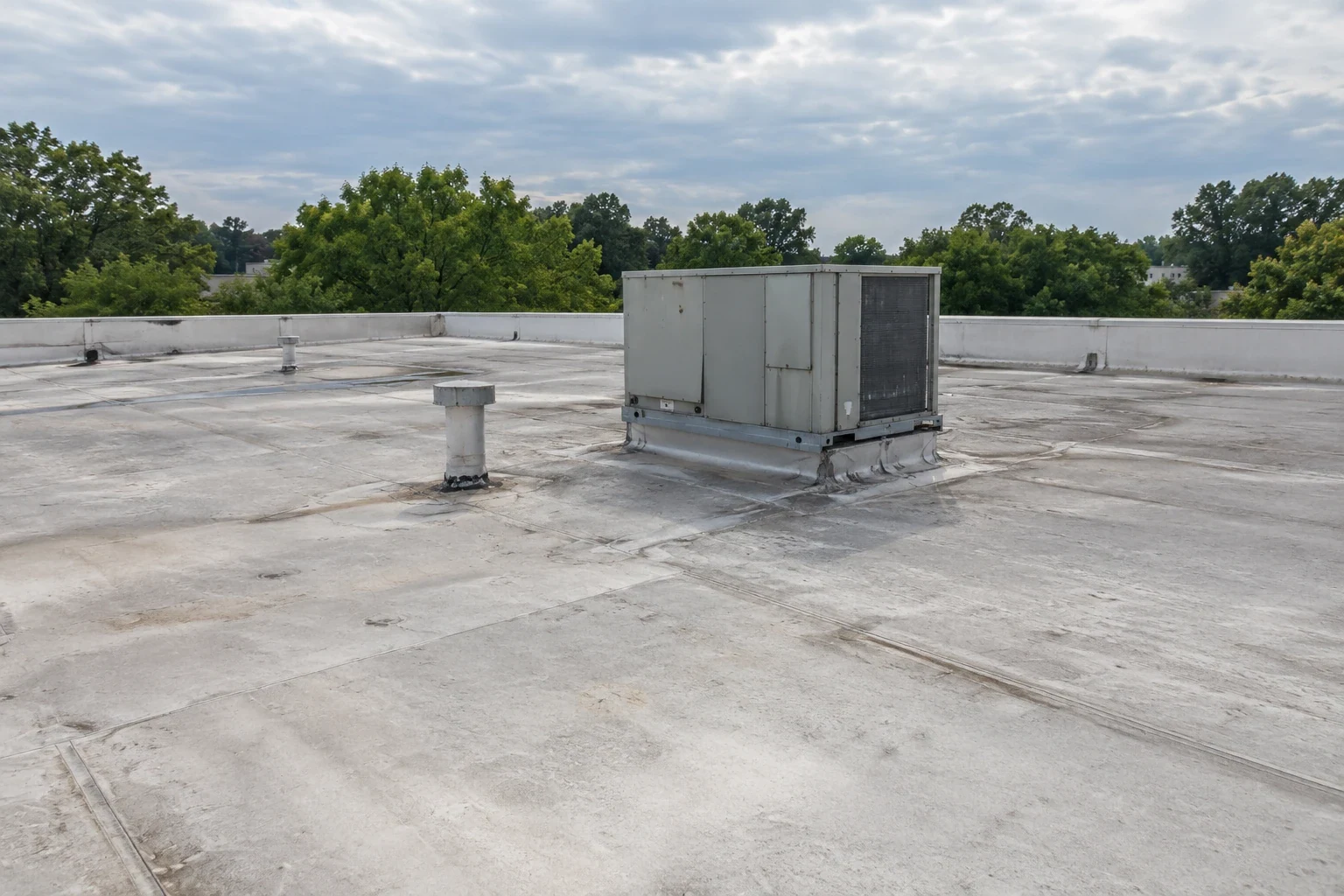
Questions About Military Installation Roofing
Local: planning from Fayetteville
I-49/US 71 is the only fully controlled access route through the area, linking Fayetteville, Springdale, Rogers and Bentonville, so a crew based in Fayetteville can reach facilities to the north without long detours. Arkansas Highway 112 runs about 8 miles north from Cave Springs to Bentonville and about 16 miles south to Fayetteville.
A federal project follows its own specification on top of whatever the 2021 International Building Code adoption requires locally. For facilities managers in Fayetteville, Bentonville and Rogers, the next step is a short conversation: the address, the roof type if known, the leak location, the access procedure and the dates that must be covered, plus a contact on the facility side who can authorize access. A roof walk can then be scheduled and the approvals started in parallel.
Commercial Roofing Questions
When can work begin after award?
Not immediately. Gate access, escort assignment and submittal review come first, and together they fix the earliest start.
Who picks the roofing system for a military building?
The project specification, built on the Unified Facilities Criteria. We install what it and the manufacturer require, and point out any conflict we find.
What happens during a training block?
Dates can move on short notice. The roof is sealed at the end of every shift so a halt leaves nothing open, and restart dates are confirmed with the facilities office.
Are deliveries checked at the gate?
Many facilities inspect vehicles and loads. A delivery list goes in early, and drops are timed for when inspectors are free.
Can an urgent leak be handled on base?
The same access rules apply, so response time depends on how quickly an escort and gate clearance can be arranged. Setting up a standing arrangement before storm season helps.
Related Commercial Roofing Pages
Read how we handle this work in Fayetteville, AR
Read how we handle this work in Fayetteville, AR
Read how we handle this work in Fayetteville, AR
Read how we handle this work in Fayetteville, AR
Read how we handle this work in Fayetteville, AR
Read how we handle this work in Fayetteville, AR
Read how we handle this work in Fayetteville, AR
Read how we handle this work in Fayetteville, AR