Edge Metal, Coping and Gutters in Fayetteville, AR
Edge metal, coping, gutter and downspout repair for commercial roofs in Fayetteville, AR, with wind securement, hail dents and freeze-thaw weeks in mind.
A strip of coping that lifts a half inch in a March gust looks like a small thing from the parking lot. On the roof it is the start of a longer story: wind gets under the edge, the membrane under it loosens, and the next storm line finds a gap to push water through. Edge metal is the thinnest part of a roof system and the first thing wind finds, which is why it earns its own line in a repair budget.
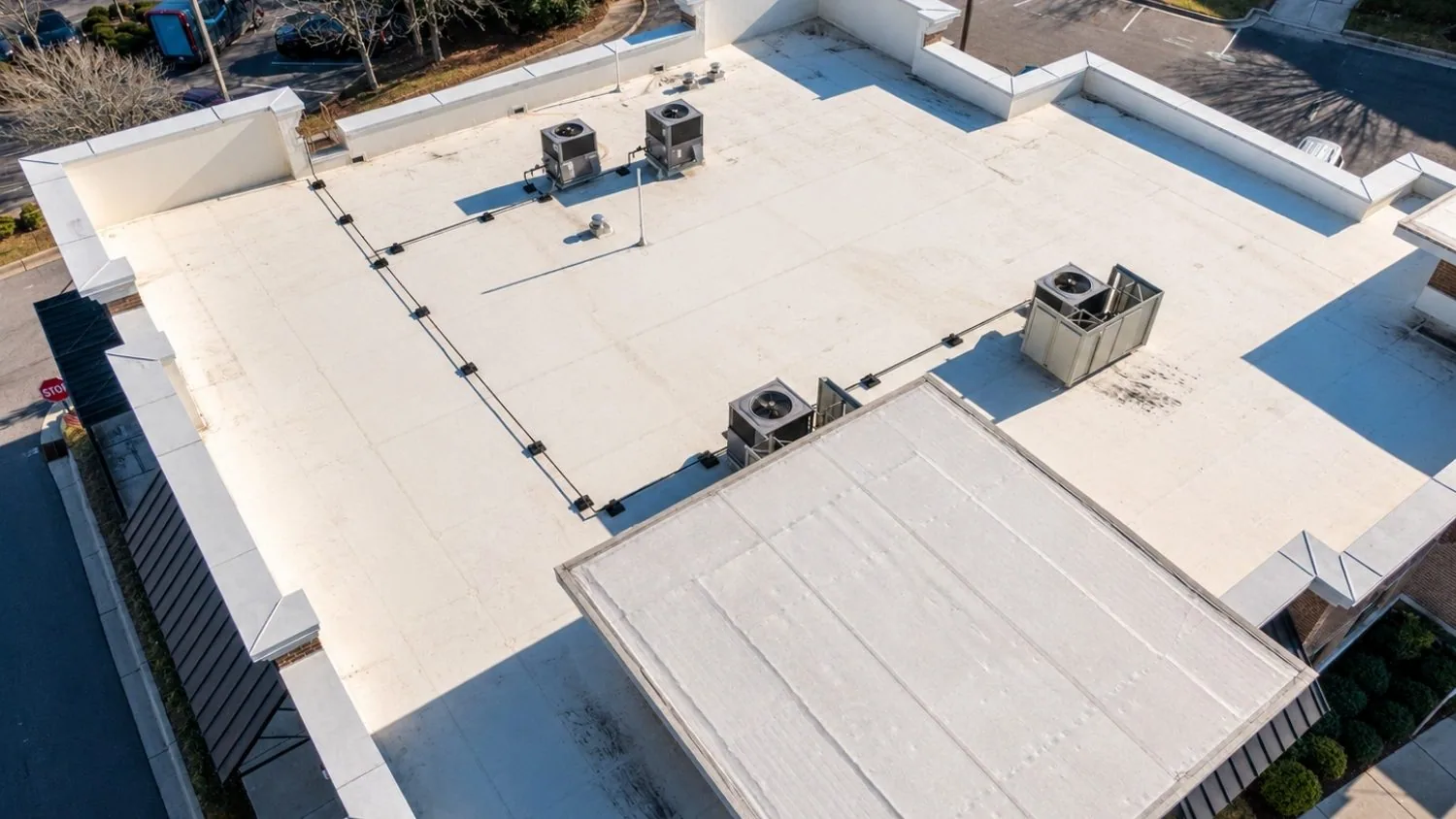
We look at the metal that frames the roof before we look at anything else: coping caps, drip edge, gravel stops, fascia, gutters and downspouts. In Northwest Arkansas it takes wind, hail and a handful of hard freezes every year, and it holds up only if it is fastened right.
Wind: why the perimeter fails first
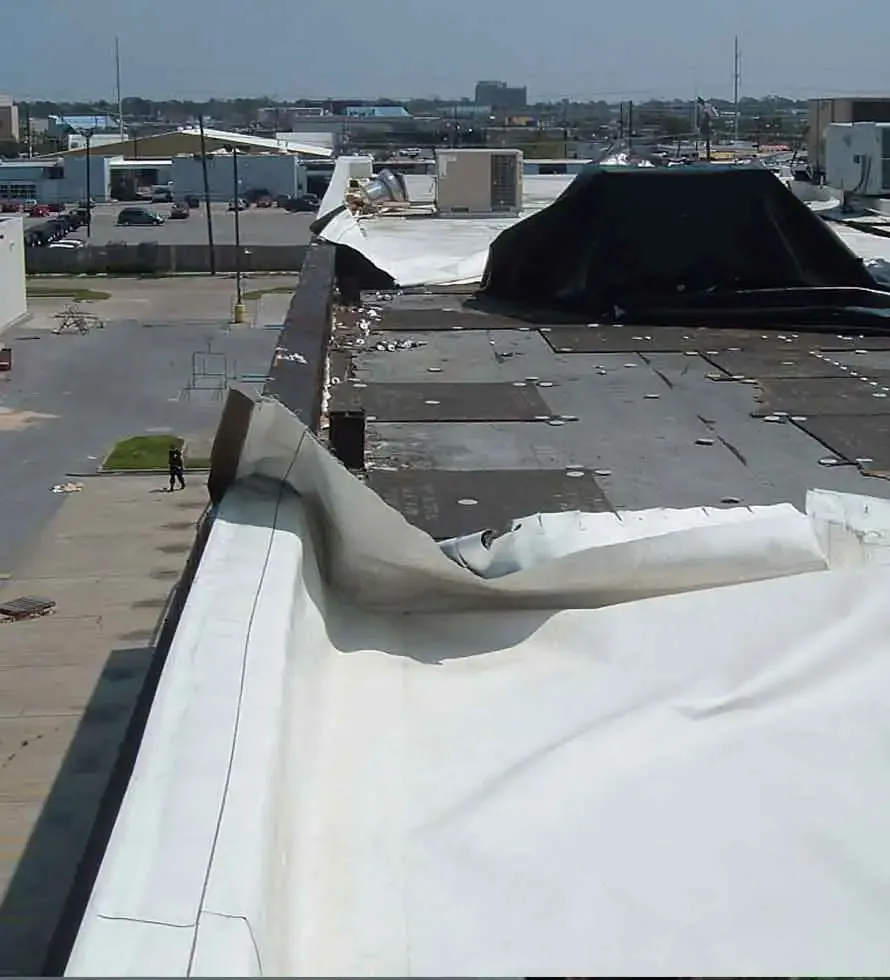
Wind speeds up and drops pressure at roof edges and corners, so those zones see the highest uplift. Springdale's March 30, 2022 tornado, an EF3 with an estimated 145 mph peak wind, took a wall and part of the roof off a city maintenance shop and destroyed a large metal building near Highway 412; most storms are far milder, but the edge is where a roof starts to peel. That peeling starts at the corners, where the uplift runs highest.
We check each run of metal for loose or missing fasteners, open joints, bent flanges and sealant that has dried out. Cleats and continuous bars hold better than face-nailed strips, and we recommend them where a run keeps coming loose. A wind damage repair at the edge costs a little if done before the membrane lifts and a lot after.
Fasteners matter as much as the metal. Screws into a wood nailer need the right length and spacing, bolts set in masonry need sound substrate, and a fastener that backs out in a freeze-and-thaw week gives the wind a handle. We replace loose ones with a larger or longer type where the substrate allows and note any nailer that has rotted, since a cap fastened into soft wood will not stay.
Coping: caps, joints and the parapet below
Coping covers the top of a parapet wall and keeps water out of the wall and the roof tie-in. It fails at joints, at corners and where sealant has dried. Water that gets under a cap runs down inside the parapet, stains the interior wall and rots the substrate, and the stain may appear a floor below the roof.
Downtown Fayetteville's Historic Square has buildings dating from 1886 to 1911, and walls on older buildings do not always match stock coping sizes, so we measure each wall before a cap is ordered or bent to fit. The same measuring walk shows whether the wall below the cap is dry and sound. New coping gets a continuous cleat, sealed joints with slip plates, and end dams where the run stops, and the wall below is dried and checked before the cap goes on.
Gutters: sizing, slope and where the water ends up
Gutters carry roof water away from walls, doors and parking. They fail from clogs, sagging brackets, wrong slope, undersized sections and ice. A gutter that holds water ages quickly, and one that overflows at a door creates a slip hazard in winter. Downspouts that end at a foundation can send water back toward the building.
We check the size against the roof area, the slope toward each outlet, the bracket spacing and where the downspout discharges. Gutters here take ice loads, since a typical year has about 10 days with highs below freezing and 6.5 inches of snow, and heavy melt can pull them off a fascia that was never meant to carry it. Where an old gutter has failed, replacement with heavier gauge and closer brackets is usually the better spend than repeated reattachment, and the work order lists the options with prices.
Hail: dents, finish and the questions to ask
Stones of 3.00 inches fell about a mile east-northeast of Fayetteville in May 2020, and metal near the edge keeps a record of that kind of hit. Hail dents edge metal, gutters and downspouts easily, and dents can be purely cosmetic or can crack the finish and open a seam. Metal near a roof edge also shows a hail pattern more clearly than the membrane does, and a good record of the dents helps the owner decide whether the damage is cosmetic or functional.
We photograph the dents with a scale, count them per run and note any that have broken the coating or opened a joint. That feeds an insurance claim when one is filed, and it tells the owner whether repair or replacement of the metal makes sense. Cosmetic dents on a sound run are often left alone, and the report says so.
Cost: repair, refasten or replace
Three levels of work cover most edge calls. Refastening and resealing a loose run costs the least and fits when the metal is sound. Replacing a damaged section fits when only part has failed. Replacing the whole run, usually with a heavier gauge and a better attachment, fits when the metal is corroded, dented through or was undersized from the start.
We price each level for each run so the manager can see the spread. A run that can be refastened for a small sum should not be replaced, and a run that has failed three times should not be patched a fourth. Edge work is often scheduled with a commercial roof repair or a recover, since the roof is already open and access is already in place. The photo record shows what was found at each run, with the run numbered on the roof plan so the manager can see which sections are done and which are waiting.
Questions About Edge Metal, Coping and Gutters
Local: roofs with long edges
Industrial Park West in Fayetteville holds a single-story industrial building of 24,750 square feet, and the retail and processing buildings across Springdale and Rogers add long perimeters of their own. A long perimeter means more edge metal to fasten, more joints to seal and more places for wind to start. Each run still gets inspected on its own, since no two edges age the same.
For owners in Fayetteville, Springdale and Rogers, we walk the perimeter first, mark every loose or damaged run on the roof plan and give a priced list before spring. Metal is among the cheapest items to fix ahead of the March to May storm stretch, and among the costliest to ignore.
Commercial Roofing Questions
How do I know edge metal is loose?
From the ground, look for gaps, lifted flanges and sealant hanging from joints. On the roof, a loose cap moves under hand pressure and shows bright, clean metal where it rubbed. We test every run.
Is coping the same as flashing?
They overlap but differ. Coping caps the top of a parapet wall, while flashing seals the joint where the roof meets the wall. Both can fail, and we inspect them together.
Do I need to replace a dented gutter?
Not if it still holds water and is not cracked. Dents that are only cosmetic can stay. Dents with broken finish or open seams are worth repairing.
Why do gutters pull off in winter?
Ice and heavy melt load them past what weak brackets can hold. Closer bracket spacing and heavier gauge reduce the risk, and clearing the line before the cold weeks helps.
Can edge metal be done without a full reroof?
Yes. It is usually a stand-alone repair, priced by the run, and it often prevents a bigger problem by keeping the membrane from lifting at the perimeter.
Related Commercial Roofing Pages
Read how we handle this work in Fayetteville, AR
Read how we handle this work in Fayetteville, AR
Read how we handle this work in Fayetteville, AR
Read how we handle this work in Fayetteville, AR
Read how we handle this work in Fayetteville, AR
Read how we handle this work in Fayetteville, AR