Silicone Roof Coatings in Fayetteville, AR
Silicone roof coatings in Fayetteville, AR: restoring sound low-slope and metal roofs that hold water, with prep, cost and recoat expectations laid out plainly.
A roof that holds water after every rain is the roof a silicone coating was made for, and a climate with this much rain produces its share of them. Drake Field logs about 113 days of measurable rain a year, 46.96 inches in total, and a low-slope roof with a shallow dip near a drain can stay wet for a day or more after each storm. Many coatings do poorly under that treatment. Silicone does not break down in standing water, which is why owners with ponding problems ask for it.
We apply silicone coatings to sound roofs to extend their life, and we say so when a roof is too far gone for a coating to be worth the money.
The same three questions come first on any coating job: will it stop the leaks, how long will it last and what does it cost against a new roof. The path to each answer starts on the roof with a moisture scan, a few core cuts and a close look at the seams. Coating money is wasted on a roof that needed a tear-off, so the scan comes before the quote.

What it is: a liquid rubber that cures on the roof
Silicone coating is a liquid polymer rolled or sprayed over a cleaned roof in one or two coats. It cures into a flexible skin that bonds to metal, single-ply membranes, modified bitumen and spray foam. White formulations reflect sunlight and lower the roof surface temperature.
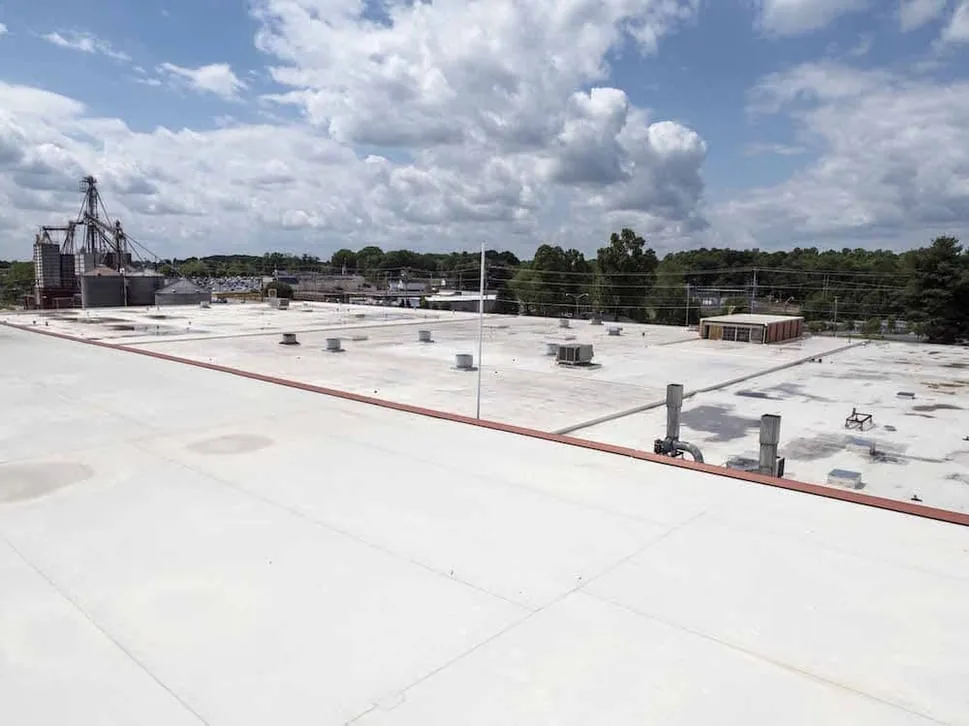
The coating is not a roof by itself. It protects and seals a roof that is already dry and sound, bridging small cracks and sealing fasteners and seams. It cannot hold back a roof with wet insulation, and it cannot repair a deck that has failed. The first step is always a moisture test.
Solids content and thickness are worth asking about. A silicone with higher solids leaves more cured material per gallon, so a given thickness takes less product and holds up longer. Compare bids on mils applied across the roof, not gallons delivered, since two crews can use the same product at very different coverage rates.
Water: why silicone suits a wet climate
May is the wettest month at Drake Field, at 5.89 inches, and the year runs to about 47 inches. Acrylics can soften and wash out in prolonged ponding, while silicone sheds it without losing adhesion. That is the main reason to choose silicone for a roof with low spots, and an acrylic coating is the lower-cost option for roofs that drain well.
Silicone has trade-offs. It picks up dirt, since the surface stays slightly tacky, and a dirty white roof loses some reflectivity. It is also slippery when wet, so walkway pads are needed. And once silicone is on a roof, few other coatings will bond to it, so the choice is close to permanent.
Ponding does not always disappear after coating. A coating covers the roof; it does not change its slope. Where a pond is deep or long-lasting, we may recommend tapered insulation or an added drain before coating, so the water leaves. A coated pond is still a heavy load and still a place for dirt and algae to collect.
Fit: roofs that can take a coating
Coating suits roofs with sound membranes, dry insulation and tight seams. Low-slope retail around Pinnacle Hills, where the center is a single level of about 934,000 square feet with a neighboring power center, and industrial buildings in Fayetteville Industrial Park are the kinds of properties where coating questions come up. A moisture survey settles whether a given roof can take one.
Metal roofs are a strong candidate, since silicone seals fasteners and laps and stops many leaks without a recover. A metal roof retrofit fits when panels are tired but not rusted through.
Single-ply membranes can be coated if they are clean and well adhered, but adhesion must be tested. We apply a test patch and pull it after a cure period before committing to the whole roof. Mod bit and spray foam roofs are common coating candidates too, with their own prep steps.
Prep: what decides how long it lasts
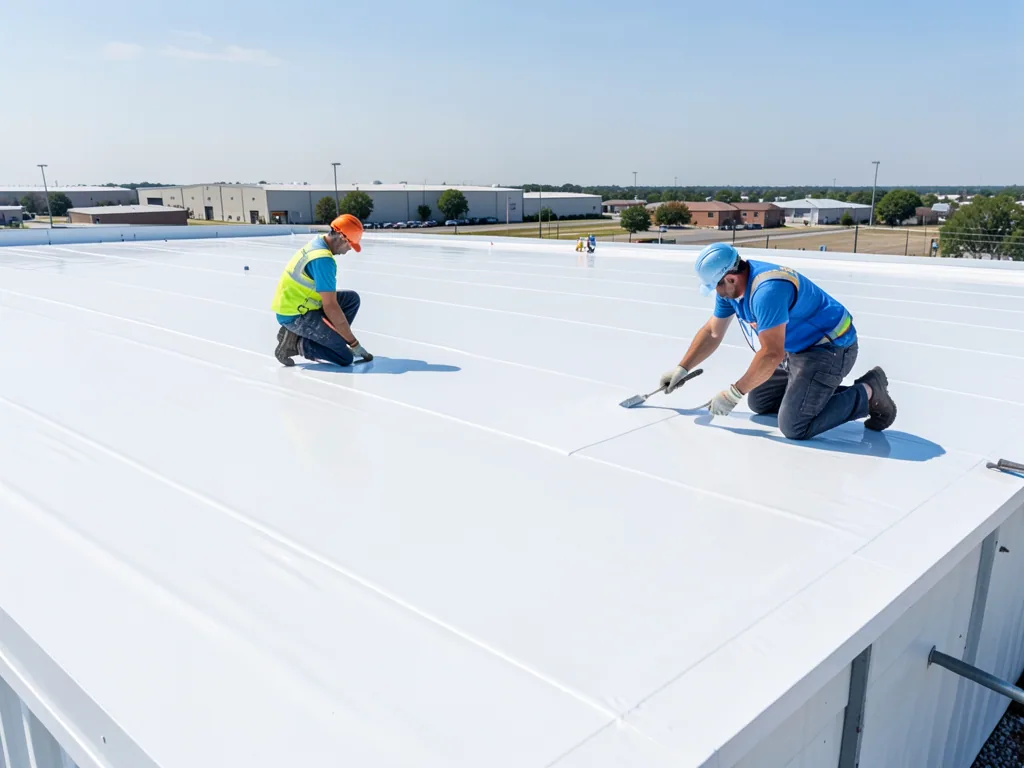
Cleaning, repairs and primers matter more than the coating. The roof is pressure washed, loose material is removed, seams and flashing are repaired, and a primer is applied where the manufacturer's data sheet requires one. Rust on metal is treated before it is coated.
The coating is applied to a specified thickness, measured in mils, with wet film readings taken across the roof. A thin coat is a short-lived coat, so we record the thickness and the area coated each day. Skipping prep or thickness to save a day is how coatings fail early.
Weather during application is a limit. The substrate has to be dry, the temperature in range and rain not forecast for the cure period. In the Ozarks, a May storm line can ruin a coating day, so crews watch the forecast hourly and stop early when a front is near.
Cost: against replacement, and the recoat cycle
Coating costs a fraction of a replacement, and it avoids tear-off, disposal and disruption. It does not reset the clock fully. Most coatings need maintenance and an eventual recoat, and the roof underneath keeps aging. We give the manager the coating price, the likely life and the point at which replacement becomes the better buy.
The best time to coat is late spring through early fall on a dry roof, and July highs average 88.7 degrees at Drake Field, so most days are workable. Winter temperatures, with a record low of minus 20 degrees in February 2021, are out of range. The capital planning line should include both the coat and the recoat.
Tenants rarely notice a coating job. There is no tear-off noise, no hot work and little debris. The main disruption is the smell of solvent-based primers on metal, and the occasional blocked walkway.
Questions About Silicone Roof Coatings
Records: thickness, batch and inspection
The file should state the coating type, the thickness, the batch numbers and the area. A roof condition report after the work records the baseline, and a yearly look afterward shows dirt, wear and any damage from hail or foot traffic. Coating does not change insulation, so code questions are fewer. Arkansas still uses the 2021 International Building Code with an energy listing of ASHRAE 90.1-2007 if the scope grows into a recover.
Owners with buildings in Springdale and Rogers can keep the same format in each file.
Commercial Roofing Questions
Can silicone stop all leaks on an old roof?
No. It seals cracks, seams and fasteners on a sound, dry roof. Wet insulation and failed decks have to be repaired first, and we scan before we quote. If the scan shows wet board across a large area, we say so and price the replacement instead.
Will silicone make our building cooler?
A white coating bounces sunlight off the roof and keeps the surface cooler, which can trim the cooling load. With July highs near 88.7 degrees at Drake Field, summer is when that shows. How much it saves depends on the insulation and how the building is used, so we give a range, not a promised figure.
Why is a silicone roof slippery?
The cured surface is smooth and can be slick when wet. Walkway pads at access points and equipment keep technicians safe.
Can we switch coatings later?
Silicone is hard to recoat with anything else. Another silicone coat is the usual path, so the decision should be made with that in mind. An acrylic can be refreshed with acrylic, and the first choice on a roof tends to be the last.
How soon after a hail storm can we coat?
After damage is repaired and the roof is dry. Dents that crack the old surface need patching, and the adjuster should see them first. We photograph and map the damage before any coating goes on, since a coating hides evidence.
Related Commercial Roofing Pages
Read how we handle this work in Fayetteville, AR
Read how we handle this work in Fayetteville, AR
Read how we handle this work in Fayetteville, AR
Read how we handle this work in Fayetteville, AR
Read how we handle this work in Fayetteville, AR
Read how we handle this work in Fayetteville, AR
Read how we handle this work in Fayetteville, AR
Read how we handle this work in Fayetteville, AR