Roofing for Hotel Owners and Hospitality Groups in Fayetteville, AR
Roof repair, replacement and planning for hotel owners and hospitality groups in Fayetteville, AR, scheduled to protect guest rooms and event weekends.
A hotel loses money one room at a time. A stained ceiling in room 214 takes that room off the board for the night, and if the leak spreads along a corridor, a whole wing can go with it. A general manager does not need a lecture on membranes. The questions are how many rooms are at risk, how fast the water can be stopped and when the permanent fix can happen without costing a sold-out weekend.
In Fayetteville, the busy weekends are easy to name. Razorback Stadium holds 76,212 and has been expanded twice, in 2001 and again in 2017-2018, and home football weekends are dates we keep clear on a roof calendar. Northwest Arkansas National Airport opened in 1998 about 17 miles northwest of Fayetteville and served more than 2.5 million passengers in 2025. Guests arrive by air and by road, and the busy dates follow both.
Room count: protecting inventory when water shows up
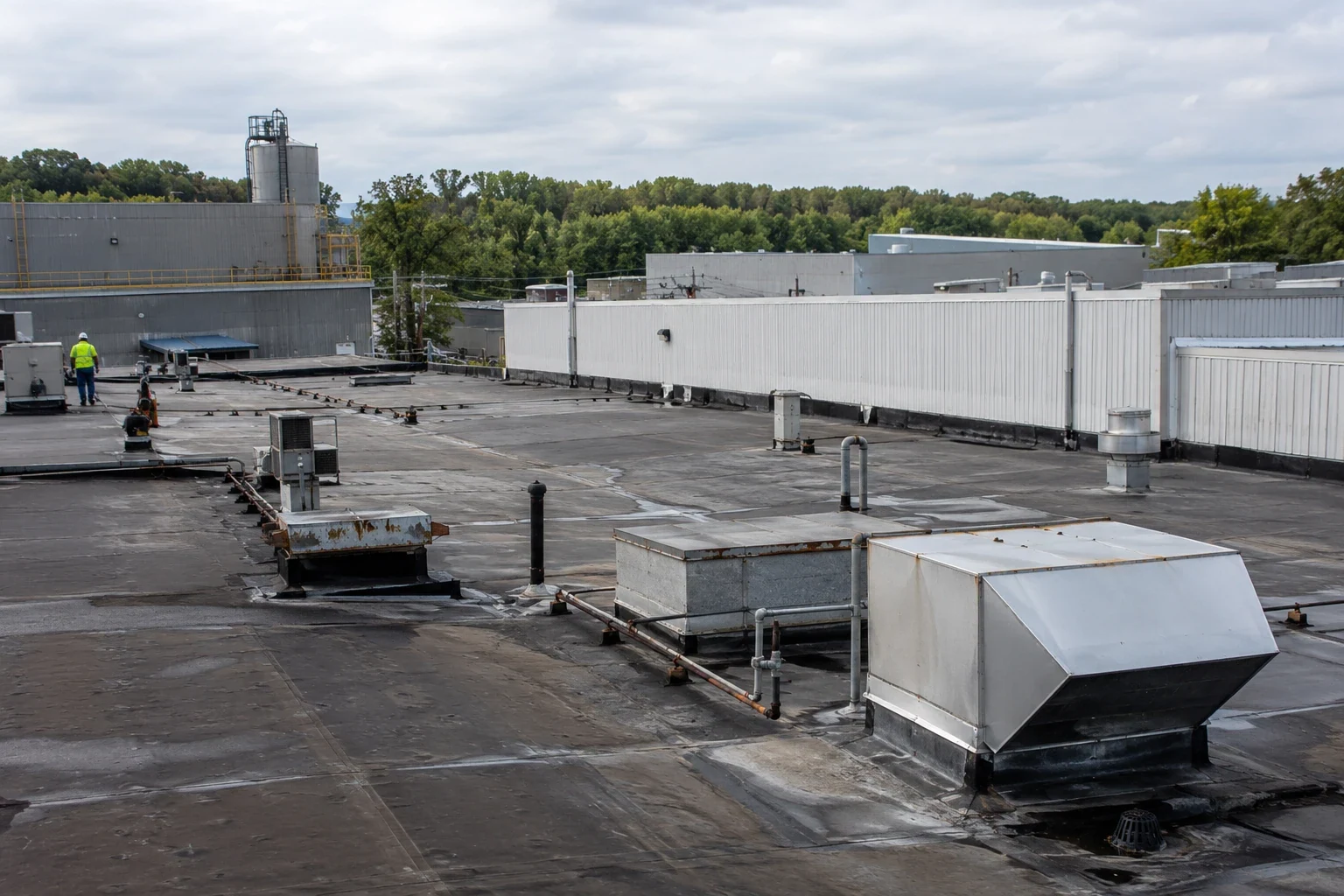
When a leak is reported, we start with the question of which rooms and spaces sit under the roof area in question. Rooms directly below a flat roof, corridors under rooftop units, ballrooms under large roof areas and kitchens under exhaust all have different exposure. We map the roof to the floor plan, then trace the water upslope to the actual entry point.
A temporary dry-in stops the loss that night. Then we set priorities: protect the rooms that can be sold, document the damage for the insurer and plan the permanent repair for the slowest stretch of the calendar. A hotel roof program that identifies weak points before they leak keeps those rooms in service, and the survey photos help show the insurer what was already known.
Event weekends: working around Razorback Saturday
The same weekends that fill rooms also fill parking lots and loading docks. We avoid noisy roof work on game days, graduation weekends and other peak dates. Our schedule starts from your booking calendar: we ask for the weeks with the fewest sold rooms and plan the job there. If the roof has to be done during a busy month, we split the work into small sections and finish each one by the end of the shift.
Noise is the guest complaint that comes first. Tear-off above occupied rooms is loud, so we place it away from sold rooms where we can, start after the morning wake-up hours and notify the front desk of the sequence. Hot work gives off odor, so we plan around air intakes, windows and pool decks. A quiet, clean job is easier on staff and keeps review scores out of the repair bill.
Access is the other half of the plan. Crews need a path to the roof that does not cross a lobby or a guest corridor, a place to stage material away from the main entrance and a spot for the dumpster that does not block deliveries or the valet lane. We walk the property with the engineer or the general manager, mark the path and agree on it in writing. A back-of-house freight car, a rear stair or an exterior ladder can serve, and we protect finishes along the route with floor covers and corner guards.
Flat roofs: pool decks, atriums, ballrooms and mechanical
Hotels combine roof types in one building. The main block may have a low-slope membrane, the porte-cochere a different one and the atrium or ballroom a large flat area with many penetrations. Pool equipment and kitchen exhaust add heat, moisture and chemicals. Each of these sections ages differently, and we rate each one in its own line.
Details around rooftop units, skylights and pipe penetrations are where most leaks start. We check skylight and penetration flashing on every visit, test sealants and note any unit that sits low on its curb. If kitchens or laundry vents release moist air near the roof edge, we look for staining and soft membrane. A repair here costs far less than replacing a ceiling and a carpet.
Drainage deserves the same attention. Hotels with several roof levels send water from an upper roof onto a lower one, and a downspout that discharges onto a membrane without a splash pad wears it out. We follow each drain and downspout to its outlet, check overflow routes and recommend splash pads, extensions or reset drains where water lands on the roof. These small fixes protect the roof below and cost little to install.
Hail, tornado wind and heat: what a storm season costs a hotel
Stones of three inches came down east of Fayetteville in a May 2020 storm. A roof that took stones that size can have bruised insulation and cracked coatings with no visible hole. The EF3 tornado that crossed Springdale on March 30, 2022 ripped roof and wall from a city shop at the airport, a reminder of what wind does to a building edge. Highs above 100 F arrive about three times a year and the record is 111 F, which makes seams and sealants work hard through a Fayetteville summer.
After any storm, a quick survey of the roof identifies what is open, what is bruised and what can wait. Our emergency roof repair crew answers at any hour, holidays included, and we pass photos to your insurer the same day. A written record helps the claim and sets the repair order. When an adjuster and an insurance restoration team are already on the property for interior work, we coordinate so the roof repair and the drying schedule do not collide.
Capital planning: when to replace and how to phase it
Most hotel owners want to spread roof costs. We survey every roof section, rate each by condition and propose a phased plan. A strong section may wait while a failing one is replaced. For a group with several properties, a roof capital plan places the largest jobs in the slowest seasons and avoids two replacements in one year.
Many owners also renovate the interior on a cycle. If a room refresh is planned, the roof should be checked first, because fresh drywall under a leaky roof is money wasted. Owners with sites in Fayetteville, Rogers and Bentonville can have each site surveyed on one trip, and a restaurant on the property can be added to the same visit.
Questions About Hotel Owners and Hospitality Groups
Commercial Roofing Questions
How soon can you stop a leak over a guest room?
Call our emergency line at any hour. A crew goes to the roof, stops the water at the entry point and gives you a list of rooms to hold until the ceiling dries.
Can the roof be replaced while the hotel is open?
In most cases, with a plan. We work in sections, avoid sold-room blocks, protect pool decks and entrances and close in at the end of each shift. A name at the front desk gets the daily schedule.
Will roof work disturb guests?
We aim to keep noise away from occupied rooms and start work after morning hours. Odor control and dust barriers protect rooms near air intakes.
What should we send before the first visit?
The property address, the roof age if known, floor plans if you have them, and the weeks with the lowest occupancy. Add any past leak reports.
How do you handle insurance after a storm?
We document the roof with dated photos and notes, sort storm damage from older wear and walk the roof with the adjuster if asked. The written record keeps the claim moving.
Related Commercial Roofing Pages
Read how we handle this work in Fayetteville, AR
Read how we handle this work in Fayetteville, AR
Read how we handle this work in Fayetteville, AR
Read how we handle this work in Fayetteville, AR
Read how we handle this work in Fayetteville, AR
Read how we handle this work in Fayetteville, AR
Read how we handle this work in Fayetteville, AR
Read how we handle this work in Fayetteville, AR